Roots and Early Beginnings
Daniel was born and brought up in Mumbai’s Mazgaon, known for Matharpacady, a 400-year-old East Indian village with Portuguese-style houses, much like Goa.
“I am from Mazgaon, but my roots are very much Goan. My father is from Chinchinim, and my mother is from Merces. I visit Goa and love everything about it.”
Daniel says his parents, Sam Judas Dias and Ditoza Rose Dias, introduced him to music. “When I was 5, my mother asked me what instrument I wanted to play. I thought of the fanciest instrument I could and picked the violin. I really fell in love with it when I began playing in the Bombay Chamber Orchestra.”
Over the years, Daniel mastered the violin under several big names. “I was privileged to learn from Luis Filipe de Sousa, Manuel de Souza, and Jini Dinshaw, who eventually encouraged me to join the Orchestra.” Today, Daniel remains an active member, playing the violin and occasionally the harp.
Discovering the Harp
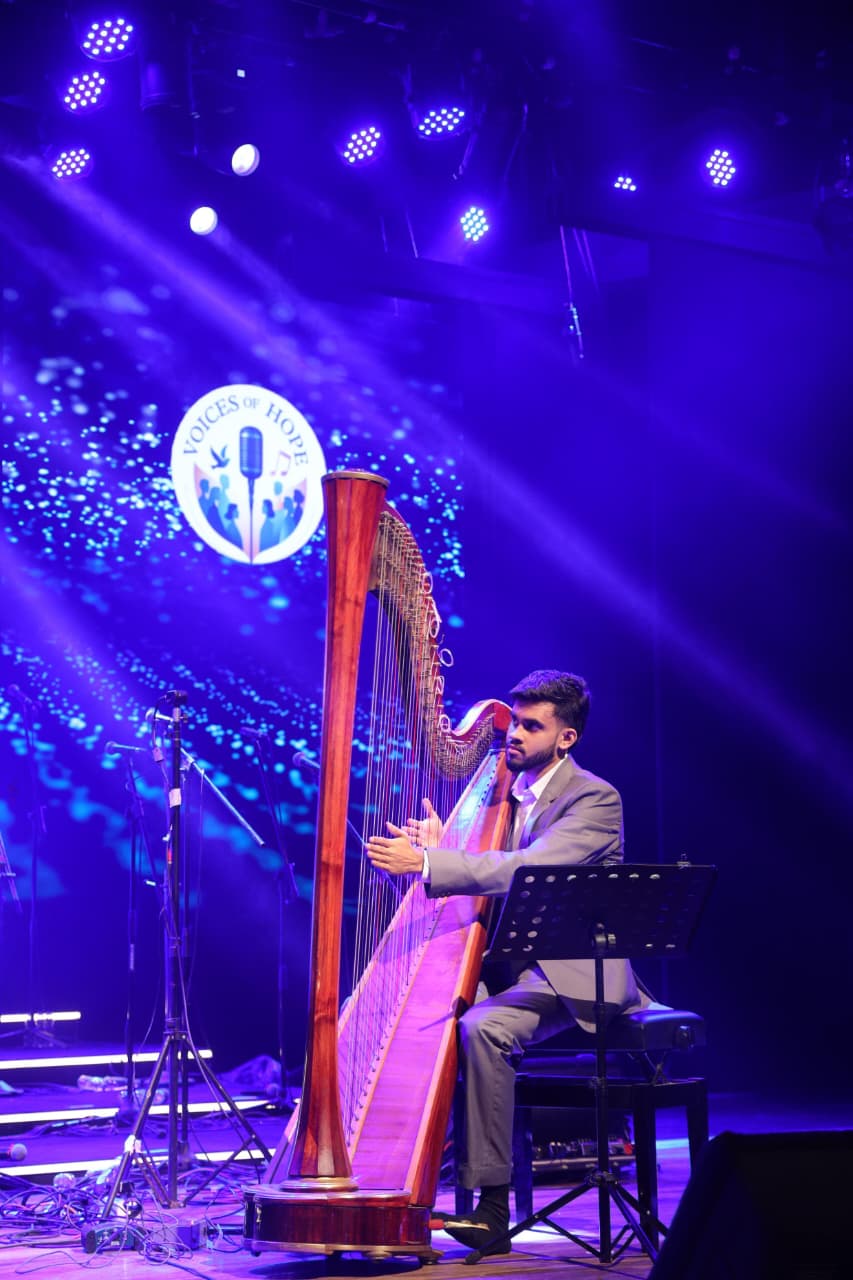
“I came across the harp in 2016 through a Christmas carol. The instrument interested me because it involved the use of both hands and feet. Later in 2018, I watched a video of Meagan Alphonso. She is just like me, born and brought up in Mumbai but originally from Aldona. I began taking harp lessons from her while navigating my studies at IIT Guwahati.”
The harp is unique and rare to find in India. It has two types: a lever harp, which uses hand-operated levers to change notes, and the more complex pedal harp, which uses 7 foot pedals to change the tuning.
Daniel faced challenges accessing one. “I bought and began learning on a lever harp in February 2019, but the desire to play a pedal harp grew. When I returned from college, I rented a pedal harp because they are expensive and difficult to source. Eventually, with help from Furtados and lots of research, I managed to purchase one.”
Dedication and Maintenance
The maintenance of the 47-stringed instrument is not simple. “The harp is delicate and requires maintenance. The wood tends to expand and contract in Mumbai weather, so we had to build a room specifically designed for it. It is temperature-controlled and has a dehumidifier to protect the harp from damage. The strings also require care because they are not very easy to source,” explains Daniel.
However, his love for music surpasses these challenges. “I believe the harp is very versatile and not confined to a particular genre. If you have the right arrangement, you can really play anything.” His Instagram shows covers ranging from classical tunes to jazz and Konkani songs.
The Mazgaon Serenaders
The harp is not Daniel’s only special talent. He was also the brain behind the ‘Mazgaon Serenaders’ -- a cultural group performing traditional Goan mando and dulpods. The group originated from a simple family performance and grew to nearly 40 members.
The reasoning behind this endeavour is to bring back lost traditions. “Many cultural groups perform mandos, but they are not authentic in replicating the mandos of old. These performances have cheapened over time, involving non-traditional instruments and failing to represent the accurate attire and dances,” Daniel explains.
The beauty of the ‘Mazgaon Serenaders’ is that they now include Damanese traditional songs, similar to the Goan mando style. “While doing research, I came across Damanese music similar to the Goan mando. In fact, Remo Fernandes’ ‘Maria Pitache’ is inspired by a Damanese song.” By incorporating music from Daman and Goa, the group reminds the audience of cultural ties between the two former Portuguese colonies.
Viral Success and Future Hopes
This attention to authentic sound and past repertoire paid off online: when Daniel posted his harp cover of ‘Mollbailo Dou’ on Instagram, it quickly raked in thousands of likes, views and shares.
“I have been posting covers for a while, and wasn’t expecting anything from this reel. It had been in my drafts, so I simply posted it, and suddenly I realised it gained quite a few shares. It was honestly slightly overwhelming,” he says.
Now he hopes to use this attention positively. “I want more people to know about the harp. When people see it, they often want to touch it; someone even mentioned the only time they had seen a harp was on ‘Tom and Jerry,’” he adds.
Hoping to inspire young musicians, he shares a word of advice: “If you really have the passion for something, just do it; don’t think too much about it.” Daniel Dias has successfully renewed interest in both an uncommon instrument and old Goan traditions, and is looking forward to doing so much more.