Anthony Kuttappassera’s family has lived in the same house at the edge of the Arabian Sea for more than a century. He grew up drinking water from the pond and the well outside his home.
But 60 years ago, that water became too salty to drink. Then it grew too salty for bathing or washing clothes. Now, the pond is green, buggy and nearly dry ” just like the rest of the wells and ponds in the Chellanam area of Kochi, a city of about 600,000 people on India’s southwestern coast.
Rising seas from climate change are bringing saltwater into the freshwater of places like Chellanam, rendering unusable what had been a vital part of everyday life. And frequent breaks in the pipelines that bring freshwater from inland exacerbates the misery for residents in this village of about 8 square kilometres, requiring water to be trucked in.
Each truckload of water has to be poured into barrels and buckets and carried by hand to the village’s 600 households.
“We do not have clean water for even cleaning ourselves. We are surrounded by water but we do not have any consumable water,” the 73-year-old Kuttappassera said. “When this pond was in usable condition there was no such issue and we had enough water for everything. There was no need for any other source. But now we are using packed water for everything.”
Although saltwater invasion of crucial groundwater supplies is a climate change problem around the world, richer nations can adapt more easily. It hits harder in countries like India, expected to surpass China as the world’s most populous nation this year. India is still regarded as a developing nation even as it has grown into one of the world’s largest economies.
India is the world’s third-highest emitter of carbon dioxide, which contributes to global warming. The nation is increasingly prioritising a transition to clean energy, with ambitious targets for renewables, a green hydrogen initiative to make clean fuel and a programme encouraging individual citizens to live more sustainably.
But that shift will take time. Meanwhile, rising seas, changing ocean patterns, extreme storms, overuse of wells and over-development all contribute to the growing salinity problem in the Kochi region, scientists said. And that challenge in coastal areas comes in a nation where access to freshwater was already an issue. Less than half of India’s population has access to clean drinking water, according to UNICEF.
“People are suffering because the aquifers are getting salinised,” said Bijoy Nandan, dean of marine sciences at Cochin University of Science and Technology. Salinity has increased by 30% to 40% since the first studies of water in the area in 1971, he said.
S Sreekesh, a professor at Jawaharlal Nehru University, studied the worsening threat in the Kochi area looking at satellite, tide gauge and other data from the 1970s through 2020. He found seas rising by about 1.8 millimetres a year.
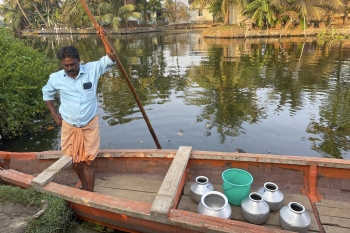
Getting water in Chellanam is always difficult, but the pipeline breaks make it even harder. The daily struggle could be seen during a recent outage that lasted about a month. Bringing the water in by truck ” or rowed in via small boats ” was only a start in a game of going from bigger pots of water to smaller.
Four giant trucks carrying 36,000 litres of water made it as far as a church parking lot, but couldn’t go any farther due to narrow winding streets. Their water was transferred into smaller tankers: 6,000 litres, 4,000 litres and even a toy-like 1,000-litre truck.
Those smaller trucks then made their way toward deliveries along one of the wider roads, stopping every few metres where large blue barrels were set up. The truck driver would hop out, connect a tube and turn a spigot to slowly fill barrel after barrel. Residents then dipped silvery aluminium 5- and 6-litre pots into the barrels.
Maryamma Pillai, 82, is among residents who wait on a truck nearly every day to get clean water. With no tap at home, she has to either buy water ” about 40 rupees, for 5 litres ” or wait for the government tanker truck to get it for free.
A heart condition makes it particularly difficult for Pillai to carry her seven pots and buckets the 100 metres back to her home. She has to take breaks as her chest grows heavy.
“I don’t have water for anything at home, not even washing my face, so I try to gather water in as many sources “ buckets, pots and tumblers ” to take back home,” she said, thumping her chest to ease the tightness that often comes when she carries heavy objects.
Pillai said water scarcity is getting worse every year as summers become more extreme.
“This was not the case earlier when we used to know how to plan for which season with more water availability but now everything is unknown, unpredictable and unreliable,” she said.