Atika Modassir
For The Goan
A brass band never arrives as a background score. It arrives like a relative—loud, warm, and palpable – impossible to ignore, no matter your preoccupation. Before you realise, you transform from a passive listener to an enthusiastic participant in a collective milestone – a wedding festivity, village gathering, feast procession, or even a funeral. Each band has a distinct personality fashioned by the verve of the musicians and the hamlets they hail from, with their signature reverberance and improvisations – vibrant and dauntless like the human spirit.
Distinct from algorithmic playlists, it makes us linger and inhabit life as it unfolds – reflecting on a procession, little feet pattering alongside, and the ladies looking out of their windows, anticipating a spectacle. You’re drawn in by that glint of polished instruments, the booming resonance, and the tale the music reveals. The story a Goan brass band tells harks back centuries; a far-reaching global history stretching from the sprawling Ottoman Empire, Europe’s ambitious battlefields, sea-strewn Portuguese trade routes, to the quiet, serpentine lanes of Goan villages.
The origins of the oldest military marching bands date back to the 13th-century Ottoman Empire, which projected pomp and power with its Mehterân drums, horns, and wind instruments. Impressed, European armies adopted them by the 17th century, making them a salient feature of their regiments. However, long before the Europeans brought brass instruments to India, Maratha martial musicians, Mughal ‘naubat’ ensembles, and some princely states already maintained ceremonial bands. However, organised military bands as we know them today arrived in India with British cantonment life. In time, Indian regiments adapted their own brass arrangements, and presently the Indian Defence Forces are the most prolific in the world, with 60 brass bands, over 400 pipe bands, and fife-drum corps.
Goa’s rendezvous with Western music, though, came in the wake of Portuguese merchant ships in 1510. While devotional, folk, and classical music were already flourishing in Indian traditions, Goa was unique in the degree to which Western music became ingrained in daily life – unlike in other parts of India, where it remained confined to military enterprise. This was the great Goan twist – an extraordinary cultural transformation that took Western music from the ranks of class and institution straight into the heart of family observances and village squares. Instruments signifying command the world over turned into instruments of camaraderie. Of course, the catalyst for this alchemy was Goa’s thriving culture, which promoted music through its zatras and folk artists, accompanied by instruments like the ghumott, mhadalem, flutes, and cymbals. While musical training was within the gurukul system, temples, and performing communities, the Portuguese further introduced Goans to European liturgical music on an institutionalised scale through seminaries, church choirs, and parish schools.
In time, this nurtured talent that sustained bands and orchestras, which became a fixture of Goan culture. Hence, unlike other places, Goa did not simply inherit a colonial or military ritual, but marched to the beat of its own drum by taking it from parades to processions. This turned the Goan brass band into a drifting treasurer of life’s cherished memories, notching the passage of time – the unbridled joy of running alongside festive processions as a child, the romance of “our song” played at a wedding, and, in moments of loss, a dignified elegiac aide-memoire that all human journeys conclude in farewells.
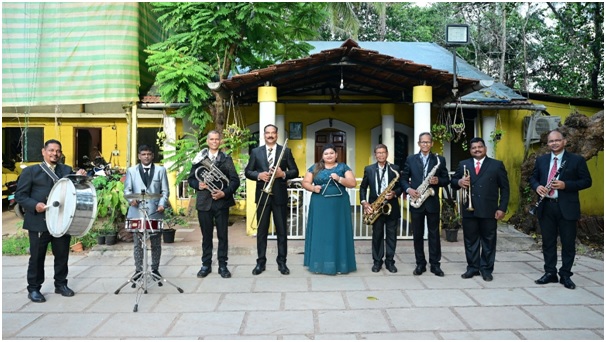
It was therefore fitting that Sunaparanta Goa Centre for the Arts chose the Azavedo Brass Band to culminate the exhibition marking Mário de Miranda’s birth centenary – ‘Growing Up in Mario’s World’. Led by the Azavedo maestro duo, the nine-member ensemble charmed audiences with an extensive repertoire, drawing on their rich musical experience from military, police, fire service, church, and community bands. Roque Lazarus describes them as a union of veterans from eight neighbouring communities, keeping the tradition alive for over four decades.
The strength of their music lies not just in the songs they play but in the way they respond to the moment, as seen in an instance Putush recollects: “We were hired at a wedding only for the bridal procession, and an electronic band was to play for the rest of the celebration...but rain knocked out their sound system, so we simply carried on and ended up playing throughout the celebration. That’s what makes a brass band different—we need just our instruments and musicians.”
As Semy Bragança professed, “Brass breathes live sound; no machine can replicate it.”
Whether it is former Portuguese President Marcelo Rebelo de Sousa requesting a photo opportunity or crowds celebrating the feast of St Cecilia at Merces, the band brings melody to all. Living traditions flourish by evolving, so I wondered whether brass bands had changed over time.
Putush responded affirmatively: “Years ago, you wouldn’t see ladies in a brass band. Today, they play alongside the men, and that’s one of the best changes we’ve seen, bringing new life to the tradition and giving me confidence that it will continue inclusively for generations.” A heartening attestation indeed, that Goa’s brass bands will continue heralding our gratitude for life – inviting reflection on its transience and the remembrance of its beauty.
(The writer is a Human Capital Strategist and Educationist; meaning she invests in humans like blue chip stocks and teaches them how not to crash the market)