This rainy, monsoon season, despite the almost violent windy spells, always strikes one as a season for renewal, for planting ideas, for undertaking new initiatives. The fresh green in its many hues, the slightly less congested roads, and the fields (some, sadly not all) which turn green once again remind us that this is a time for renewal and rebirth.
Maybe because we are caught up more at being home, it’s a good time for new ideas to sprout. This has been my thinking for some years now; and it does work. Why not try out something new? The worst that could happen is, it would not work.
Talking about this reminds one of the green initiatives that sprouted online, quite accidentally in my own case. Cyberspace provides space to promote new ideas and try out something different.
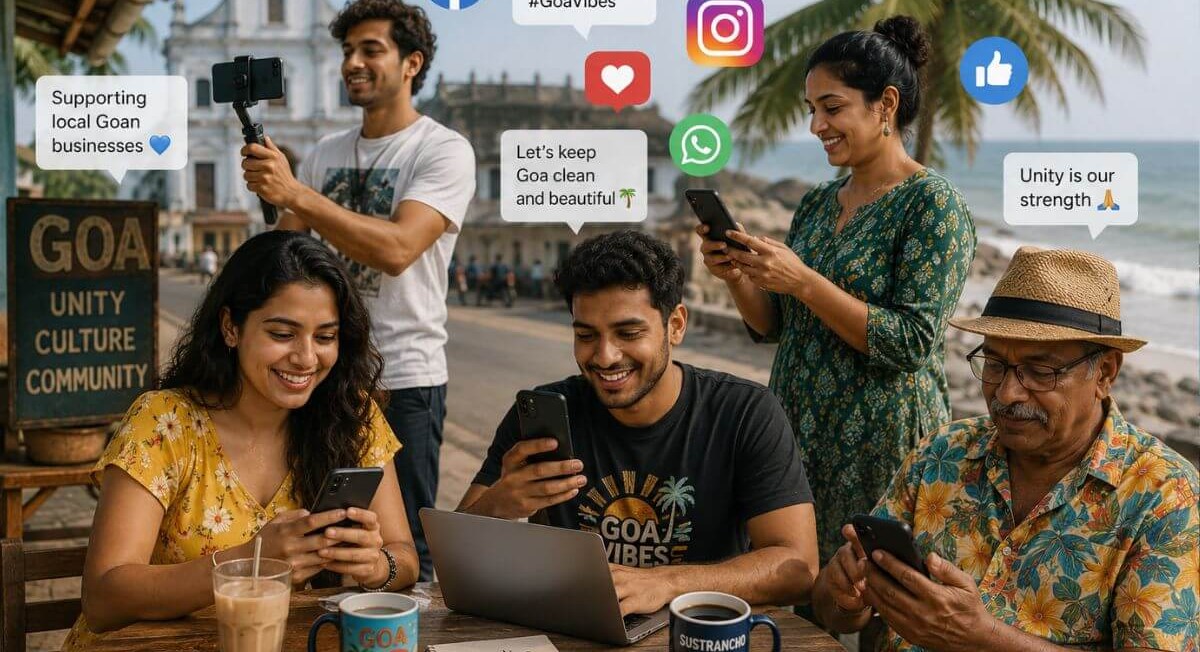
Facebook is an elder’s thingy. Instagram has got all the young people on it. WhatsApp (despite some irritating aspects to it) can offer instant communications, and reach out to a number of people, middle-aged, young and elderly.
Contrary to those who are dismissive towards the social media, this is a tool which can be used… for negative or positive purposes. If we are clear, we can focus on the latter.
The social media tends to get a lot of needless flak. Some dismiss it as “WhatsApp University”, a reference to the half-baked and dubious knowledge that can sometimes come through this route. In times when email and mailing lists held sway, those who found it difficult to cope with incoming mail would grumble and say: “Oh no, not yet another mailing list!”
But that misses the point.
A well-used knife an be used to heal, or even to prepare a tasty meal. It doesn’t necessarily have to be a tool that causes murder and mayhem… and rarely does. Likewise, when used aptly, the social media we have access to, can also play a positive role.
The environment continues to be an important issue for Goa. Needless to say, there are some environmental groups which play a useful role in sharing information and building networks.
Ones that are open on my tab include Green Goa, a generic group meant to discuss environmental issues. Likewise, Green Fingers is meant to share information about plants and the like. There is also a Goa Green Brigade, which takes on a more activist stance towards campaigning against what they see as environmentally destructive policies. Including the felling of trees, and other such issues.
In the past few days, the Green Goa group has been discussing water woes (in the midst of the monsoons) affecting some parts of Goa, a planned meeting with the mayor of Panaji, tree falls, suspected illegal hill cutting, and more.
While some could discuss this approach as “anti development”, if one looks closely it is clearly a way citizens are campaigning to safeguard the region they love and care about.
Likewise, the Green Fingers is another group of a non-profit, non-political and non-religious kind. It aims to promote green causes and an interest in greenery, including plants.
Contrary to the skepticism of others, it is possible to see the potential of cyberspace to promote new and positive ventures. One of these was born in the form of the Saligao Seed Bank. While the group’s name has a village identity embedded in it, it is not restricted to that area alone. It may have started off in Saligao, but spread to anyone (within Goa and even outside, infact the moderator, Marianne Nazareth, is Bengaluru-based) interested in the issue of plants.
Initially meant to be a centre for sharing seeds, it quickly grew into a space to discuss everything related to plants. It describes itself thus: “This group is meant to discuss about plants, seeds and trees in Goa and beyond.”
Somewhere along the way, someone suggested that Goa needed a group to discuss organic fruits and veggies available for sale. That proved to be a good suggestion, as the group quickly touched 1024 members (the maximum a WhatsApp group can take) and another parallel group needed to be started.
Likewise, there are groups which focus on Goan cooking, where some generous souls share what they know, and the how-tos of preparing various traditional dishes available in the region. Or beyond.
This is not to suggest that everything is hunky-dory and smooth sailing here. As we know, there can be the occasional backbiting and nasty comments that hit even those willing to generously share their knowledge. One nasty note sent from an person who thinks s/he is anonymous can upset the applecart for all. Such incidents have cropped up occasionally.
Nevertheless, it is still worth the effort and the pains put in. Building online communities is a challenge in itself. It has its risks and its difficulties, but with some selflessness, it is possible to create a useful fund of social capital that all can benefit from.
Small societies like Goa have special need for this. Spaces like Goa can gain from well-curated social media initiatives if these manage to build trusted and active online communities where members regularly stay in touch. They can share updates here, trade information, and build on positive ideas and energies.
Likewise, these tools can even be used to coordinate events (like some farmers’ markets do in newer locations of Goa). Skill exchanges are another possibility.
A well-moderated Facebook, Googlegroup or WhatsApp group (the last one doesn’t allow for pre-moderation), supported by regular useful posts and photo updates, encourages participation. It builds relationships. It can foster a sense of belonging.
Can Goa separate the chaff from the wheat, and be able to create something lasting from something ephemeral like cyberspace? Can social media become a powerful tool for building trust, creating reciprocity and boosting community engagement—not just online, but offline too? Time will tell…