


In order to accord perspective to the Report in respect of the State of Goa in comparative focus to the rest of India, it would be pertinent to iterate the highlights of the scientific study by the SAC:
- 15 per cent of India’s coastline ” amounting to nearly 1,144 km ” is undergoing erosion
- With the anticipated sea level rise, increased wave activity, and projected increase in the frequency and intensity of tropical cyclones due to climate change are expected to cause more rapid and severe shoreline changes in the near future
- India gained 4,042 hectares of coastal area between 2004-06 and 2014-16; West Bengal, Gujarat, Odisha, and Goa have suffered a net loss of coastal area due to erosion in the course of 10 years
- Goa lost around 15.2 hectares of coastal land due to sand erosion over ten years; the lowest length of the accreting shoreline is in Goa (7 km)
- Around 20 per cent of the 139-km Goa coastline has been washed away due to rising sea levels
While the Coastal Zone Management Plans (CZMP) formulated under the Coastal Regulation Zone Notification (1991) needs to be exalted for being the pioneering piece of legislation issued by the Government of India under the Environment Protection Act, 1986 and administered by the Ministry of Environment and Forests (MoEF) in order to protect and conserve the environment and ecosystem on the coastline of the country.
According to the 1991 notification, the coastal land up to 500m from the High Tide Line (HTL) and a stage of 100m along banks of creeks, estuaries, backwaters and rivers subject to tidal fluctuations, would be referred to as the Coastal Regulation Zone (CRZ).
And even many years thereafter, the anthropogenic demands haven’t ceased to impose a strain upon the ideal of conservation along the pristine Coastline of Goa and India.
To afford a clearer perspective about the magnitude of CRZ Violations in the State of Goa, a news report dated: 07th February, 2023 in The Goan Everyday headlined that “Over 50% of India’s CRZ violations are from Goa”.
The news report further revealed that as per the information provided in a written reply by Minister of State, MoEF and CC Ashwini Kumar Choubey in the Rajya Sabha, ‘Goa’ had reported 974 cases of CRZ violations from among the 1878 cases that were reported during the last five years across the country.
Hence, the hypothesis that CRZ Violations in Goa were an exacerbating factor to Coastal Erosion along Goa’s shoreline would be a tenable expectation capable of being demonstrated from the data available with the ISRO and other respective agencies.
But at the same time, why Goa would not be able to implement conservation measures that are innovative and effective remains a moot point.
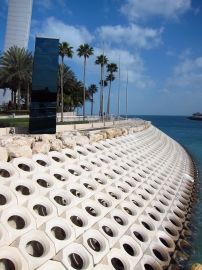
During my recent visit to Dubai, UAE in April, 2022, I recollect driving along the Jumeirah Beach Road and stopping by the Burj-Al-Arab to click a picture of the architectural marvel.
One observation that stood out in my mind were the cuboid concrete blocks with hexagonal edges that were arranged around the periphery of the man-made island upon which the structure stood tall.
In one study, it was estimated that the concrete blocks placed along the sea face worked like sponges that as waves hit the blocks, the sea water passed inside them and the kinetic energy of the wave was dissipated. Thus controlling the coastal erosion thereon.
This design innovation can be said to be instrumental in the conservation of the shoreline surrounding the man-made islands in Dubai, but pondering the application of this same principle to conserving the Goan shoreline from future degradation would be immensely desirable.
According to the Manual providing Guidelines for “Protection and Control of Coastal Erosion in India” that has been prepared by CSIR-National Institute of Oceanography, Dona Paula, Goa and released in Decemberm, 2020: The commonly used coastal erosion protection measures constituted mainly three types of approaches towards coastal protection i.e. hard measures, soft measures and a combination of hard and soft measures.
Amongst them, the common preventive solutions included the construction of sea walls, bulkheads, dykes, groynes and breakwaters, complemented by revetment systems.
Sea walls:
Sea walls are efficient structures to prevent coastal erosion and other damages caused by waves and storm surges. They are particularly well adapted when land use is at a premium such as exposed city fronts or when supporting vital transportation links.
Bulkheads:
Bulkhead structures have two functions: retaining or preventing land slidings and protecting coastlines against damages caused by wave action. They provide a well-defined separation between land and sea along protected shorelines, including in estuaries or marina basins.
Dykes:
Dykes are sea defense structures used for the protection of low coast and coastal lands against floods as a result of tides, wave run-up or storm surges.
It is a soft solution offering the advantages of geosynthetic materials and locally available fill materials.
Groynes and breakwaters:
Groynes and breakwaters are commonly built structures for shoreline management. They serve different but complementary purposes as far as littoral transport is concerned.
Revetments and articulated concrete blocks:
In areas that are exposed to strong and damaging hydraulic flows, “hard” revetments can be put in place that will allow for long term protection. Articulated Concrete Block (ACB) mattresses can also be installed to cover and protect shorelines as well as man-made structures such as dykes.


