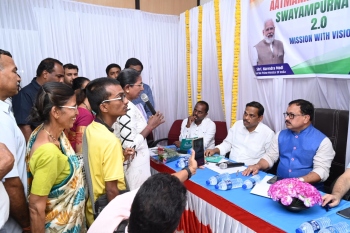
The State Government’s recent outreach initiative entitled: Prashasan Tumchya Dari prompts an introspection into the powers that
Ministers enjoy as part of their privileges under the decentralised
administrative system. Before forming any opinion about the context of the outreach initiative to the Goan reality it would only be apt to inform oneself about the decentralisation in administration prevalent in the State.
According to Craig Johnson at the Department of Political Science, University of Guelph, Ontario, Canada in Working Paper 199 (2013):
“Assertions in favour of decentralisation are often founded upon a wider critique of central state planning, which holds that large and centrally-administered bureaucracies represent an inefficient and potentially destructive means of allocating resources (and generating wealth) within society.
Two assertions are generally used to substantiate this claim.
One argues that central state agencies lack the ‘time and place knowledge’ to implement policies and programmes that reflect people’s ‘real’ needs and preferences.
A second and related assertion is that time and place gaps give local officials unlimited ability to distribute resources and extract ‘rent’ as they see fit.
Such outcomes are believed to be particularly prone in poor countries, where government represents a vital source of wealth, and mechanisms to ensure accountable governance are often poorly enforced.”
Converesely, it has been postulated:
“A problem that is well-recognised in the literature on decentralisation is that the devolution of power will not necessarily improve the performance and accountability of local government. Indeed, in many cases, decentralisation has simply empowered local élites to capture a larger share of public resources, often at the expense of the poor.”
According to the World Bank (2000), Administrative decentralization needs to be differentiated from Political and the Fiscal forms:
‘Administrative decentralisation’ places planning and implementation responsibility in the hands of locally situated civil servants and these local civil servants are under the jurisdiction of elected local governments.
‘Political decentralisation’ transfers policy and legislative powers from central government to autonomous, lower-level assemblies and local councils that have been democratically elected by their constituencies.
‘Fiscal decentralisation’ accords substantial revenue and expenditure authority to intermediate and local governments.
Administrative discretion implies the authority vested in the executive i.e. the Ministers to undertake administrative action based on their judgment.
The Supreme Court in Ram Jawaya Kapur and Ors. Vs. The State of Punjab AIR 1955 SC 549 has referred to the administrative function as “residuary functions” due to the quantum of functions undertaken by the executive other than the law-making functions and the judicial functions.
Discretionary Powers:
- A ministerial function can be understood as one where the authority has a duty to do a particular thing in a certain way. Such actions are however not exceptional.
- That in most administrative actions, the administrative authority has the power either to act or not to act in one way or the other.
- This power to act or not to act in one way or other is referred to as Discretionary power.
- Discretionary powers exercised by administrative and legal authorities are permissive as these powers have granted to these officials by statute or delegation.
- Discretionary powers would therefore not impose an obligation on a decision-maker to exercise them or to exercise them in a particular manner.
- Hence, administrative agencies must exercise discretionary powers in accordance to legal requirements based on reasonable justification.
- Discretionary power must be used reasonably, impartially and with avoidance to oppression or unnecessary injury.
- Consequently, an administrative agencies’ duties necessarily include the right to exercise discretion.
- The reason for granting discretionary power to administrative agencies is because the delegation they possess the requisite experience and specialization to confer quick decision-making in a particular area that is an agencies’ area of expertise.
- Administrative agencies have been provided with discretionary power to ascertain place and time to hear and decide matters that shall come before it.
- Agencies have been conferred the power to prosecute or enforce matters through civil or criminal process.
Then in such situations where the Administrative Discretion has been formally delegated into the hands of administrative authorities which consist of publicly appointed administrative functionaries empowered to provide rapid executive discretionary Orders to the affected parties who come before it, the State Government’s outreach initiative entitled: ‘PRASHASAN TUMCHYA DARI’ only seeks to strengthen the opinion of the public that Ministerial privilege possess the power to bypass administrative action due to its discretionary nature.
Moreover, with the outreach initiative reiterating the Sarkar Tumchya Dari and Swayampurna Goa initiative, the Chief Minister on 17th March, 2023 observed that Administrative Officers would sit in all the Grampanchayats and in every Municipality on every Saturday of the week to provide assistance to the general public whether it be to seek the benefit under any governmental scheme, etc.
This modus operandi by the State Government would imply that the Ministerial discretionary action would be most accessible to the public even though it represented the highest echelon of administrative action, thus causing the general public to give a go by to the well documented procedures enacted in the delegated legislation.
Then what good would it be to decentralise administrative action in the State of Goa, if expectations of autocracy in the form of Ministerial action are being suggestively propagated through outreach campaigns that seem more like events intended to bolster the popularity of the ruling government.
Ideally, the State Government’s initiatives would be highly appreciated if they focused on generating awareness about the correct way of doing things before the administrative authorities under the respective delegated legislations.