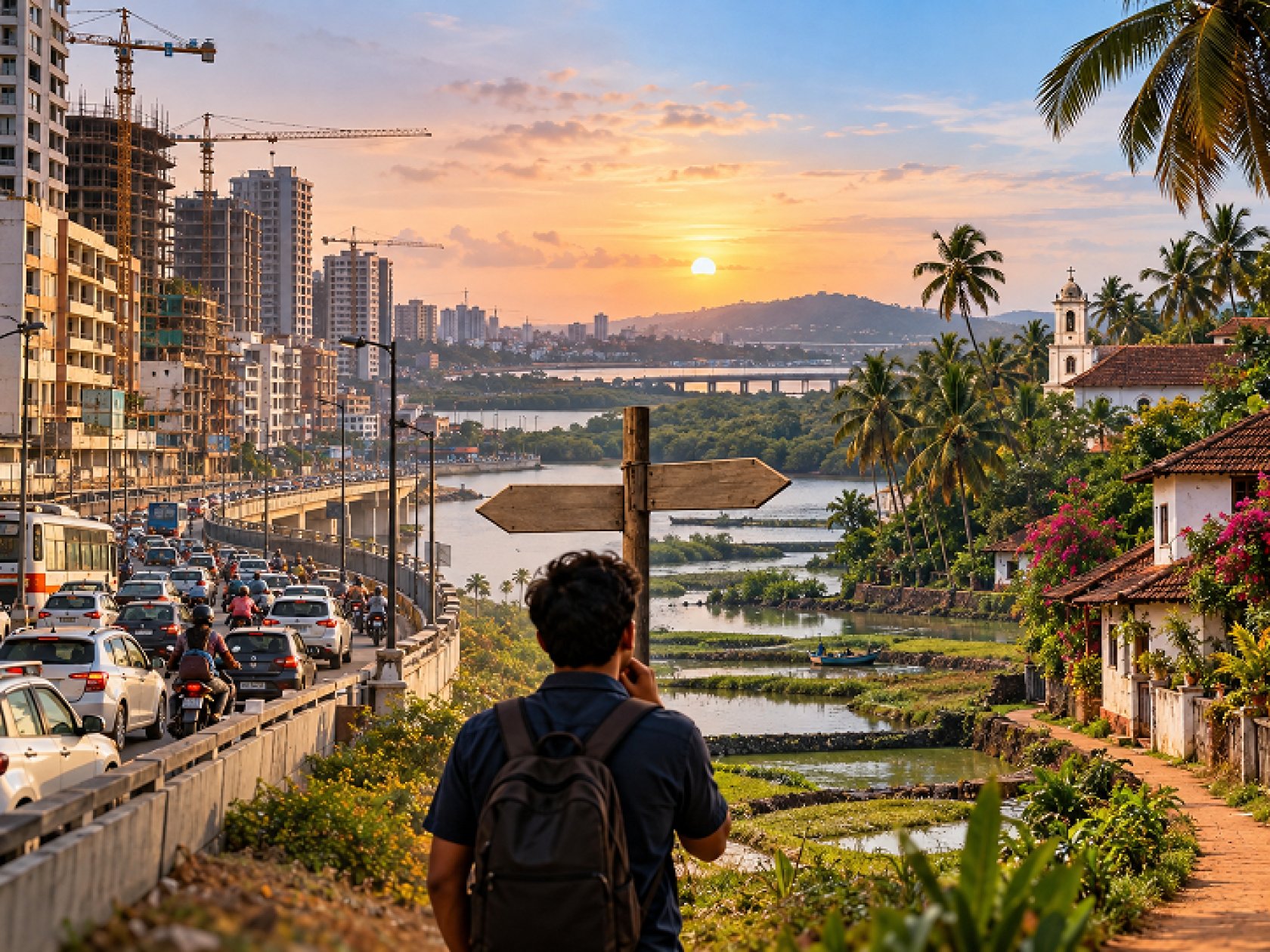
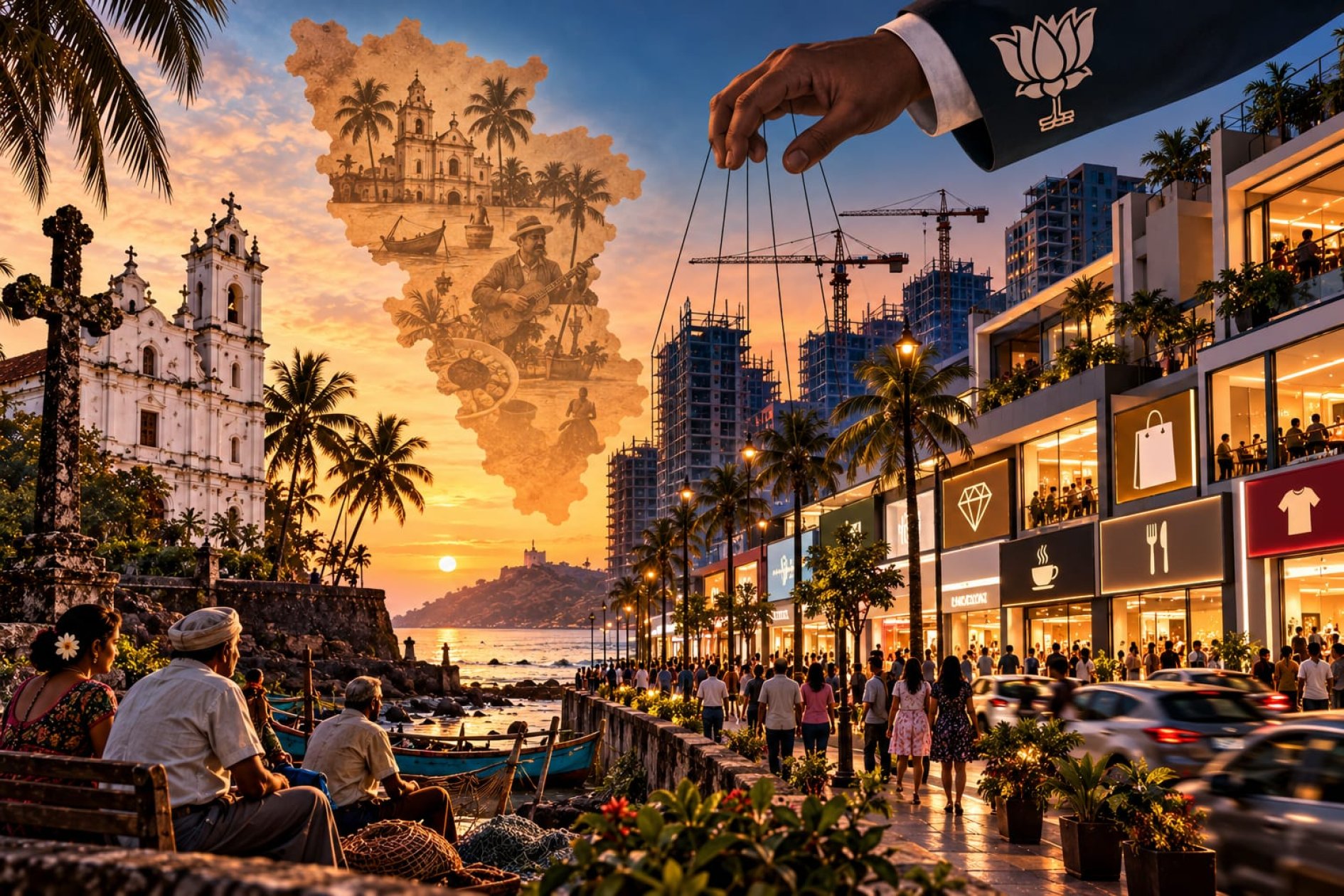
Along the stretch of Dayanand Bandodkar Marg, from Miramar Circle towards Bal Bhavan and beyond, a changing commercial landscape has become increasingly visible. International franchises, national restaurant chains and jewellery brands have joined the establishments through which Goa’s urban economy has traditionally been experienced. Starbucks, McDonald’s, Malabar Gold and Diamonds and Tanishq represent more than changing consumer preferences. Their presence raises questions about the ownership of capital, the organisation of commerce and the cultural character of a state whose identity has long been distinguished by its regional particularities. Historically, colonialism involved the extension of external power over a territory and its inhabitants, frequently accompanied by the extraction of resources, the restructuring of local institutions and the subordination of indigenous economic and cultural interests. The East India Company’s transformation from a commercial enterprise into a territorial power demonstrated how trade could become intertwined with political authority and economic control. Could Goa, therefore, be experiencing a form of reverse colonisation?
Moreover, the real question to be asked is whether the concentration of capital, the priorities of political power and the homogenisation of cultural life are combining to weaken Goa’s capacity to determine its own future.
The political economy
of preference
An examination of political financing offers one starting point. Do business interests provide the BJP with disproportionate financial support? Electoral bond disclosures provide relevant evidence. In March 2024, The Times of India reported that business families and companies associated with Goa contributed approximately Rs 27 crore through electoral bonds during the period examined. Of this amount, approximately Rs 23.1 crore, or 85 per cent, went to the BJP, while Congress received around Rs 1.8 crore.
These figures nevertheless reveal a marked imbalance within the reported dataset. When a party seeking to retain political power receives the overwhelming share of the disclosed contributions examined, questions about the relationship between political influence and commercial interests become unavoidable.
The Supreme Court’s decision to strike down the electoral bonds scheme in February 2024 further demonstrated the constitutional significance of transparency in political funding. The underlying concern is not that businesses should be prohibited from supporting political parties, but that citizens should be able to scrutinise the financial relationships that may influence public decision-making.
Consolidation of
political power
Is the BJP consolidating political power at the expense of Congress and regional parties? Goa’s recent political history provides grounds for examining the question. In 2019, ten Congress MLAs and two MLAs elected on Maharashtrawadi Gomantak Party tickets defected to the BJP. By February 2022, sixteen of the seventeen Congress MLAs elected in 2017 had moved to other parties, according to a national newspaper. Such defections substantially weakened the opposition and raised questions about the relationship between electoral mandates and subsequent legislative realignments.
When regional parties struggle to retain their elected representatives, the diversity of political voices through which Goa’s distinct interests are expressed may also be diminished.
The relationship between such consolidation and the suppression of dissent requires separate scrutiny. Nationalism can foster solidarity, but it can also be invoked to portray legitimate criticism as hostility towards the nation.
Does Goa’s investment policy facilitate the expansion of large businesses and external capital? The state’s investment-promotion framework expressly seeks domestic and foreign investment. Goa’s Investment Promotion and Facilitation Board was established to attract investors, facilitate approvals and promote the state as a business destination. Investment is therefore an acknowledged component of the state’s development strategy.
There is nothing inherently objectionable about this. Investment can create employment, improve services and expand economic opportunity. Yet the relevant question concerns the distribution of its benefits. Who owns the enterprises? How much of the resulting wealth remains within Goa? Can locally rooted businesses compete for commercial premises, finance and skilled employees? Are employment opportunities reaching Goans, and are environmental and cultural costs adequately considered?
The appearance of a national brand does not establish that its outlet is owned by an external investor. Franchise arrangements may involve local entrepreneurs. Similarly, the disappearance of a traditional establishment cannot automatically be attributed to corporate expansion. Ownership records, rental trends, employment data and business closures must be examined before a definitive conclusion is reached.
Nevertheless, where larger enterprises possess substantially greater access to capital, advertising, supply chains and commercial property, competition may not occur on equal terms. If this process progressively displaces locally rooted businesses, the consequences will extend beyond commerce. Local ownership and entrepreneurship are among the means through which a region retains economic agency.
Prospect of an
Indianised Goa
Can nationalist ideology provide political legitimacy for economic changes that disadvantage local communities? And does the combined evidence justify describing the process as economic colonisation?
The proposition that Goa will inevitably become completely Indianised under the BJP must be treated as a warning about a possible trajectory, not as an established or irreversible outcome. Goa is already constitutionally part of India. The concern is not national integration, but the possible erosion of its distinctive linguistic, cultural, economic and political character through a model of development that increasingly privileges scale, capital concentration and uniformity.
If national commercial expansion is accompanied by the weakening of regional political alternatives, inadequate protection for local enterprise and the dismissal of cultural concerns as mere nostalgia, the cumulative effect could be a Goa that remains geographically distinct but becomes progressively less distinct in its economic and cultural life.
Goemkarponn cannot be preserved through sentiment alone. Nor can it be defended by rejecting investment or treating people from other parts of India as illegitimate participants in Goa’s economy. It requires scrutiny of who controls land, capital, employment and decision-making, and whether development remains accountable to the communities that bear its consequences.
The question, ultimately, is not whether Goa should participate in India’s economic growth. It is whether Goa can participate in that growth without surrendering the distinctive character that makes it Goa.