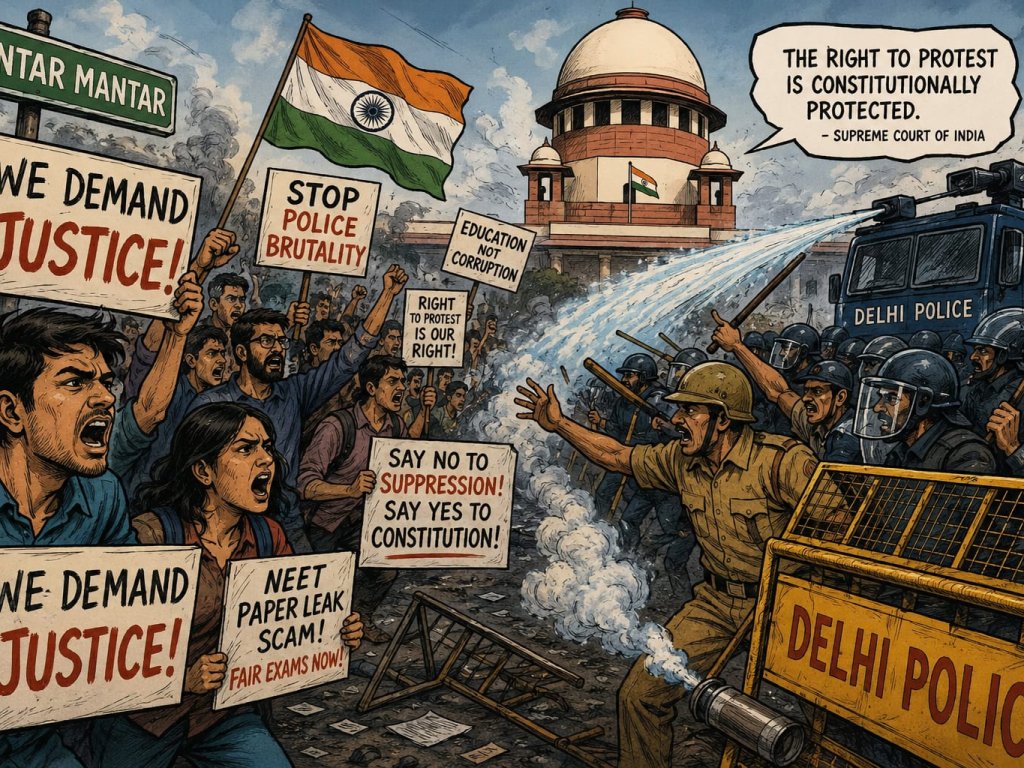
A constitutional democracy is seldom tested when its citizens applaud the government. Its true measure is revealed when those citizens choose to dissent. Protest has never been a constitutional inconvenience to be tolerated only when politically convenient. It has instead remained one of the most visible manifestations of the freedoms guaranteed under Article 19 of the Constitution. From the freedom movement to contemporary student demonstrations, India's democratic journey has repeatedly demonstrated that peaceful public dissent is not a weakness of the Republic but one of its greatest constitutional strengths.
Recent months have witnessed an unusual convergence of events. The Reservation Hatao Andolan, continuing concerns surrounding the integrity of the National Eligibility cum Entrance Test (NEET) examination and demands for educational reforms, together with growing public debates surrounding inflammatory political rhetoric, have once again brought the constitutional right to protest into sharp focus. The controversy has not merely concerned the grievances being expressed, but the manner in which those grievances have been received by the State and, ultimately, by the judiciary.
Democracy has never demanded uniformity of opinion. It has demanded constitutional tolerance. Those who advocate for the continuation of reservations and those who call for their reform remain equally entitled to constitutional protection so long as their expressions remain peaceful and lawful. Similarly, students protesting against alleged irregularities affecting one of India's most competitive entrance examinations are not merely seeking administrative answers. They are asserting their constitutional expectation that public institutions entrusted with determining their future should function with transparency, fairness and integrity.
Public controversies surrounding remarks likening political opponents to "cockroaches", followed by the emergence of a satirical political response in the form of the so called "Cockroach Janta Party", demonstrate how language itself can become an instrument of political mobilisation. Democracies undoubtedly protect robust political speech. Yet constitutional culture demands something greater than legal permissibility. It requires that public discourse continue to recognise the equal dignity of every citizen, irrespective of ideological differences.
Once political disagreement descends into dehumanising language, constitutional fraternity, which forms part of the very fabric of the Preamble, begins to suffer.
Against this backdrop, the recent observations made by the Chief Justice of India during proceedings concerning police action against student protesters deserve careful constitutional examination. Their significance lies not because they resolve disputed facts, but because they revisit enduring constitutional principles. The reaffirmation that the right to peaceful protest enjoys constitutional protection should not surprise anyone familiar with Indian constitutional jurisprudence. Nor should the suggestion that allegations of police excess warrant independent, fair and transparent scrutiny be interpreted as hostility towards law enforcement. Accountability has never been the enemy of public administration. It remains one of its essential constitutional safeguards.
Equally significant was the judicial recognition that protests often attract individuals whose objectives differ from those of the original organisers. The observation that "uninvited guests" may enter demonstrations with their own agendas reflects a practical reality frequently witnessed during large public gatherings. However, constitutional rights cannot be extinguished merely because some individuals engage in unlawful conduct. Those responsible for violence should undoubtedly face legal consequences. Their actions should not, however, become a constitutional justification for treating every peaceful participant as equally culpable. Collective punishment has never formed part of constitutional governance.
Perhaps the most consequential aspect of the Court's observations lies in its apparent willingness to revisit and strengthen institutional guidelines governing police responses to public demonstrations. India has witnessed repeated judicial interventions on questions concerning assemblies, processions and public order. Yet the recurring nature of these disputes suggests that existing safeguards often remain inconsistently implemented. Constitutional rights cannot depend upon the varying administrative preferences of individual authorities. They require predictable legal standards, consistent institutional training and transparent accountability whenever force is employed against citizens exercising fundamental freedoms.
It would therefore be misplaced to characterise judicial candour itself as constitutional impropriety merely because it proves uncomfortable for those exercising executive authority. Constitutional courts were never intended to function as silent observers when allegations arise that fundamental rights may have been compromised. Their institutional legitimacy derives precisely from their willingness to remind every organ of the State that constitutional power remains subject to constitutional limitations. Judicial independence becomes meaningful not when it produces universally popular outcomes, but when it demonstrates an equal willingness to question every centre of public power.
None of this diminishes the equally legitimate responsibility entrusted to governments to preserve public order. Peaceful protest cannot become a shield for violence, vandalism or intimidation. Equally, the preservation of public order cannot become a convenient justification for suppressing peaceful dissent merely because it proves politically inconvenient. The Constitution imposes reciprocal obligations. Citizens must exercise their freedoms responsibly. Governments must exercise their authority proportionately. Courts must ensure that neither obligation eclipses the other.
India's constitutional history has repeatedly demonstrated that social reform rarely emerges from silence. Whether the issue concerns educational integrity, affirmative action, corruption, civil liberties or institutional accountability, public protest has often served as the first constitutional signal that democratic dialogue requires renewed attention. Attempts to dismiss every protest as disorder risk weakening the very democratic culture that the Constitution seeks to preserve.
Ultimately, constitutional democracy does not ask whether governments appreciate criticism. It asks whether they remain willing to tolerate it within the framework of law. If peaceful dissent becomes conditional upon executive approval, the freedoms guaranteed under Article 19 cease to function as rights and become privileges granted at the discretion of the State. That would represent a constitutional retreat from which no democracy should willingly depart. India's Constitution envisioned a Republic in which governments govern, citizens question and courts remain fearless guardians of the liberties that bind them both together. In preserving that balance, the Constitution continues not merely to protect protest, but to protect the democratic conscience of the Republic itself.