Sherwyn FF Correia
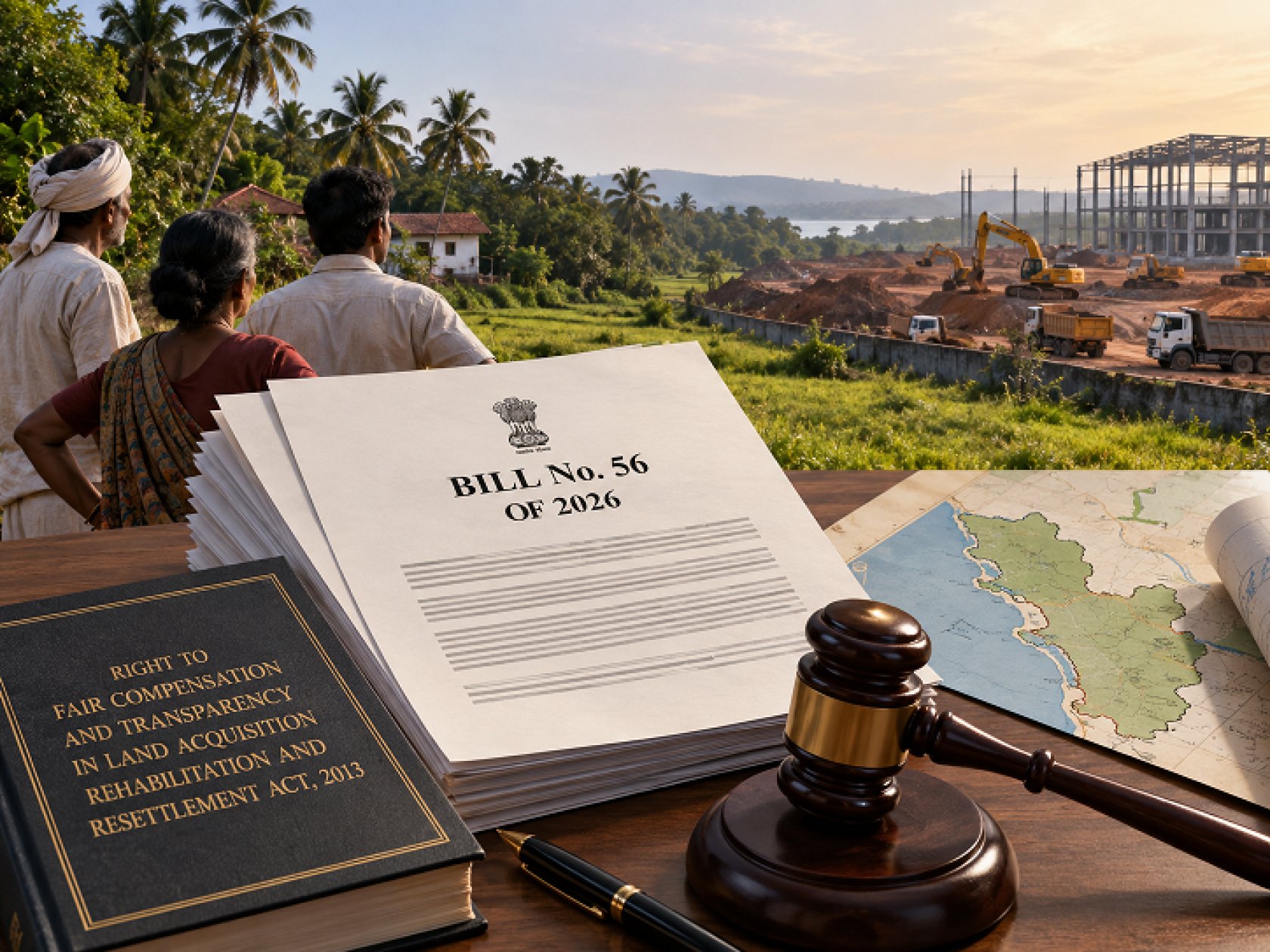
Every Bill has one sentence that gives the game away. Bill No. 56 of 2026, Goa’s amendment to the central Right to Fair Compensation and Transparency in Land Acquisition, Rehabilitation and Resettlement Act, 2013, has it in its Statement of Objects and Reasons: the amendment is needed, the government explains, where land “cannot be secured through the existing consensual mechanism.”
The existing consensual mechanism is consent. The Bill is needed because people are saying no.
You will not find Bill No. 56 in the record of the Assembly’s recently concluded monsoon session. It was cleared by the Cabinet, printed and numbered, and signed by the Revenue Minister on 31 August 2026, the day the session opened. Eighteen Bills were introduced over three days, numbered 43 to 62. 56 is not
among them.
That is a reprieve, not a resolution. The Bill can be tabled next session. But Section 107 lets States enlarge these entitlements, never cut them, so a Goa Act needs the President’s assent, and requires her instructions before any ordinance. Either road runs through Delhi.
The Bill is short: two operative clauses. The first switches off the 2013 Act’s requirement of consent from 80 per cent of affected landowners where land goes to a private company, 70 per cent for a public-private partnership. The second lets the State exempt six categories of project from Chapter II — social impact assessment, public hearing, expert appraisal — and Chapter III, which protects irrigated multi-cropped land.
So: no consent, no study, no hearing, no expert group, no food-security bar. The landowner keeps a right to object within sixty days, heard by the Collector and decided by the government that granted the exemption. It is a right to be heard. It is not a right to refuse.
Consent is not an old right. Under the British-era 1894 Act, in force in Goa post-liberation until 2013, nobody had to ask. For example, vast expanses of Comunidade land were acquired for various so-called public purposes, and the village gaunkars’ view was irrelevant. The 2013 Act corrected that; Section 10A of the Goa amendment Bill hands six categories back.
In December 2014, the Union promulgated an ordinance inserting precisely this Chapter into the 2013 Act, and re-promulgated it twice. It could not carry the provision through Parliament, and on 31 August 2015 it lapsed, eleven years to the day before the Goa Bill was signed.
What Parliament would not pass, states enacted one by one: Tamil Nadu in 2014, Gujarat and Telangana in 2016, Jharkhand in 2017, Andhra Pradesh in 2018, Karnataka in 2019. Odisha’s 2023 Bill names Gujarat, Maharashtra and Karnataka as precedents; Assam cleared its version this year. Goa’s first clause is word for word what Karnataka, Andhra Pradesh and Odisha adopted. A provision that the Union could not carry openly was assembled, one presidential assent at a time.
The government may answer that compensation is untouched, and on the Bill’s face, it is. Solatium stays at 100 per cent; the multiplier, the valuation of trees and structures and the rehabilitation award survive. But two things go, neither of them is in the text.
Section 26 fixes market value at the highest of three: the stamp-duty value, the average of comparable registered sales, or the amount agreed with landowners during the consent process. Remove the consent process and the third can never exist. Legal practitioners would know that the distance between what a sale deed records and what the land actually fetches is no secret in this trade. The two that remain come from those records.
Section 30(3) requires the Collector, in every case, to add 12 per cent a year on market value from the date the assessment is notified to the award. Exempt the assessment and that date never arrives. Karnataka, Andhra Pradesh and Odisha all amended the provisions that stop an acquisition lapsing. None touched Section 30(3). The clock was worth fixing wherever it ran against the government, and nowhere when it ran against the owner.
In fairness, Goa’s is the narrowest package of the series, and not retrospective. But at one point it goes further: its list includes industrial areas and estates set up by the State government and its undertakings, absent from the central ordinance and from the Andhra, Telangana and Karnataka Acts. Odisha capped its equivalent at 100 families displaced or 500 acres of private land; Goa’s carries no threshold. And where Andhra Pradesh, Telangana and Karnataka gave a willing owner a negotiated purchase route, Goa offers nothing for the agreement it removes.
Why the Bill was held back is not on record; governments rarely explain a Bill they cleared and never moved. A Bill is not printed and numbered by accident. Somebody must have counted something.
Supporters will say Goa needs land for “development” and cannot wait. Perhaps. But the 2013 Act was never only about compensation. It was about whether the person whose land is taken gets a say before the decision, not after. On that question Parliament would not be moved, eleven years ago. Nor should Goa be now.
(The writer is an advocate practising in the High Court, District Courts and quasi-judicial forums in Goa)