With Goa moving towards the 2027 Assembly election, political alliances are beginning to acquire shape. Congress and the Revolutionary Goans Party have agreed to proceed with discussions towards opposition unity and a Common Minimum Programme (2026). Elsewhere, preliminary discussions have reportedly taken place between the Goa Forward Party and Aam Aadmi Party over another possible political formation (2026).
The rhetoric surrounding these negotiations naturally invokes Goa, Goans, identity, land, employment and preservation of the State's character. But eventually an alliance document must encounter electoral arithmetic.
Forty constituencies have to be fought. Candidates have to demonstrate winnability. And in Goa's relatively small constituencies, a geographically concentrated bloc of a few thousand voters can become exceptionally valuable.
Moti Dongor and
politics of protection
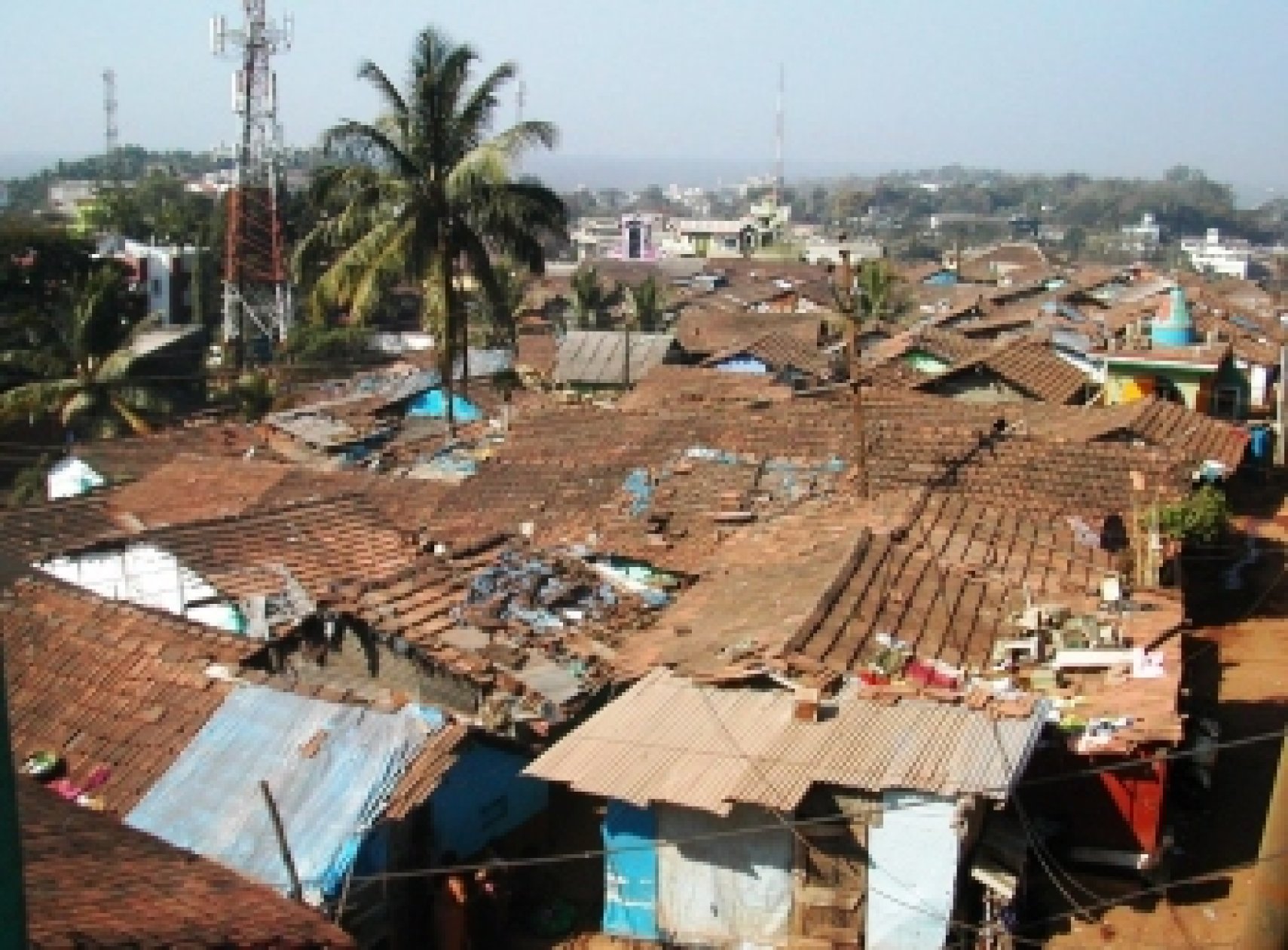
Margao provides perhaps the clearest case study. Moti Dongor has grown from a settlement of a few hundred families into one of Margao's most politically significant voting concentrations. Recent reporting placed its electorate above 2,500, compared with approximately 500 voters in 1995 and 1,900 by 2008 (2025). Its association with seven-time Margao MLA Digambar Kamat has been remarkably persistent despite his movement across political parties.
During the 2024 Lok Sabha campaign, Moti Dongor was described as Kamat's migrant electoral stronghold. While campaigning there for BJP candidate Pallavi Dempo, Kamat told residents that his prestige was at stake and sought overwhelming support for her candidature (2024). The more consequential episode came subsequently.
Against the background of longstanding controversy surrounding unauthorised structures on comunidade and other lands, Kamat publicly assured Moti Dongor residents that not a single structure would be demolished while he remained there (2025).
Should electoral choice ever become associated with an MLA's capacity to assure a concentrated electorate that unauthorised structures will remain untouched?
Calangute and Banjara
controversy
Calangute provides another variation. In 2018, the Gawada, Kunbi, Velip and Dhangar Federation publicly accused Calangute MLA Michael Lobo of courting migrant voters, particularly members of the Banjara community, through support allegedly involving regularisation of hutments and advocacy concerning Scheduled Tribe recognition (2018). Those were allegations made by the organisation, not judicial findings against Lobo. That distinction matters.
Nor should communities be indiscriminately bundled together. Banjaras or groups locally associated with Lamani/Lambadi identities possess distinct cultural histories. Kannadiga describes a much broader linguistic or geographic association with Karnataka. Interstate workers from Maharashtra constitute yet another heterogeneous population. Religious, linguistic, occupational and caste identities can overlap.
The Vasco-Cortalim
laboratory
Southwards, the Mormugao peninsula provides an extraordinary illustration. Baina, Mangor Hill, Zuarinagar, Upasnagar, New Vaddem and surrounding settlements cannot simply be attributed to one politician. They straddle Vasco, Mormugao, Dabolim and Cortalim and contain very different populations. Zuarinagar nevertheless stands out. Electoral reporting in 2017 estimated its migrant electorate at approximately 12,000 and identified Zuarinagar, Upasnagar and parts of Sancoale as areas where the migrant vote could prove decisive in Cortalim (2017). Another contemporary estimate placed Zuarinagar at around 9,000 voters within an approximately 30,000-strong constituency (2017). The estimates differed, but both demonstrated its electoral magnitude.
An earlier investigation had described approximately 4,000 allegedly illegal structures in the Zuarinagar slum and reported a voting strength exceeding 12,000 (2016).
More revealingly, residents of Baina, Mangor Hill and Zuarinagar had complained as early as 2012 that politicians appeared during elections but failed to resolve their underlying developmental problems.
Mangor Hill itself requires nuance. Two Varunapuri polling stations recorded only 41.46 and 41.38 per cent turnout in 2022, but officials attributed this substantially to transferred defence personnel remaining on electoral rolls; other Vasco booths averaged around 73 per cent (2022). It therefore cannot honestly be characterised wholesale as a migrant vote bank.
Mauvin and value
of incumbency
Dabolim MLA Mauvin Godinho presents a different political phenomenon. Godinho received 7,468 votes in Dabolim as a Congress candidate in 2012, winning by only 944. After changing political affiliation, he won for the BJP in 2017 with 7,234 votes and again in 2022 with 7,594 votes, the latter victory carrying a margin of 1,570.
In a contest decided by such numbers, even a modest concentrated electorate becomes politically valuable.
Housing regularisation has meanwhile remained conspicuous. In 2024, the Mormugao Municipal Council discussed regularisation of approximately 540 Housing Board tenements at New Vaddem in Godinho's presence (2024). In January 2025, Godinho publicly criticised the municipal Chief Officer over delays concerning regularisation of 545 houses; the officer was transferred shortly thereafter (2025).
Regularisation may be perfectly legitimate where legislation permits it. Sanitation, electricity and humane housing must never be withheld merely because inhabitants are politically inconvenient.
But governance deserves scrutiny when the elected representative becomes the indispensable intermediary between a vulnerable settlement and the State.
Contrast this with the late Matanhy Saldanha. His identification with Goa's traditional ramponnkar fishing community was not manufactured on the eve of an election. His political life grew from decades of activism concerning traditional fishing livelihoods. Community representation therefore cannot automatically be equated with vote-bank politics. That distinction should guide Goa in 2027.
An eligible citizen ordinarily resident in Goa possesses electoral rights irrespective of whether his ancestors spoke Konkani, Kannada, Marathi or another language. The more troubling possibility is that political Goa has discovered the electoral usefulness of permanent insecurity: Settlements sufficiently established to contain thousands of electors, yet sufficiently precarious that continued housing, regularisation or protection may appear dependent upon political intervention.
No voter should have to wonder whether changing political allegiance might change the security of the roof above his head. And no promise that an illegal structure will remain untouched while a particular politician holds office should ever substitute the rule of law for the politics of gratitude.
As Goa's parties negotiate alliances for 2027, perhaps the electorate should ask not merely who is joining whom. It should ask what, and whom, each politician believes he is bringing with him.