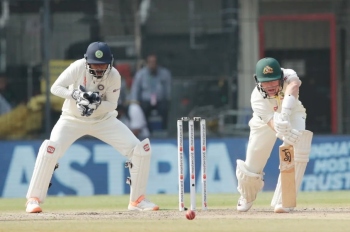
India's capitulation to spin in Indore and subsequent nine-wicket loss against Australia has brought into the spotlight their approach of using square turners from Day 1 in home Test matches. It was a role reversal of sorts as the hosts became victims of their own gameplay as Aussie spinners trumped them on an undercooked track that did too much for the liking of the Indian batters.
However, this setback is unlikely to force a change in approach from the Indian think tank about their preference for turning pitches from the start of a Test match at home. It is a template they have followed successfully at home, winning eight of their nine previous home Tests before the loss in Indore. All these results had one common ingredient -- a pitch where the ball turned from the first day. Indore is only their third Test loss at home in the last decade after defeats in Pune (2017 vs Australia) and Chennai (2021 vs England).
However, after the rare defeat on Friday, his first as India's Test captain, Rohit Sharma asserted that India won't change their spin-reliant gameplan at home. The skipper accepted that the batters let the team down and Australia masterfully exploited the conditions that, for a change, favoured the visitors. Interestingly, in this series, the team that had lost the toss won the match. India lost the toss in Nagpur and Delhi while Australia lost the toss in Indore.
The significant impact of the coin toss on the results of Test matches in India is one of the main reasons why the BCCI started asking its groundsmen to prepare turners for home Tests. Traditionally, India has been a graveyard for bowlers with its flat pitches favouring the batters. The reversal against England in the opening Chennai Test in 2021, where Joe Root's men ground India down for a famous 227-run win after winning the toss, led India to turn to the spin-heavy strategy. Using square turners took the toss out of the equation and ensured India got the maximum use of the home advantage with their world-class spinners Ravichandran Ashwin, Ravindra Jadeja and Axar Patel making merry.
As Rohit suggested, India are prepared to stick with this strategy even if it leaves them vulnerable to an odd setback when their batting fails as it did in Indore. The think tank believes playing on turning tracks gives the team the best chance to produce wins, a key to raking up points to qualify for the World Test Championship final.
Lopsided Tests no fun
A larger question though is whether this approach helps Test cricket as a modern sports product with five-day matches wrapping up in well under three days. While India struggled in Indore against Australia, earlier in the week New Zealand and England produced an all-time classic in Wellington which went down to the wire as the hosts secured an epic win by the barest of margins -- a single run. The five-day Wellington humdinger was in complete contrast to the Indore rollercoaster which, although entertaining, didn't do justice to the status of the fixture being a Test match. The main difference in these two matches was the pitch -- one provided a level playing field for the batters and bowlers while the other heavily favoured the bowlers.
Test cricket is fun when there's an equal attritional battle between the bat and the ball. In Indore, it was a no-contest even between the spinners and the pacers, forget a level playing field for the batters. Test cricket is all about the involvement of the spectators in the match. A match like Indore would certainly not attract spectators to the stadium. Not when any ordinary spinner can pitch on a length and pick a fifer while the most elite of the batters are reduced to sitting ducks. India have all the right to produce the pitches they want but we don't deserve dust bowls like Indore.