


PANAJI
For many Goans, protests have largely meant marches, speeches and sloganeering. The scenes that unfolded at Jantar Mantar in New Delhi this week, though, were of a different order altogether.
Those who travelled from Goa to join the Cockroach Janata Party’s (CJP) ‘Sansad Chalo’ protest, along with others who happened to be in Delhi on work or personal visits, found themselves witnessing towering barricades, rows of Rapid Action Force and armed police personnel, water cannons, internet blackouts and baton charges -- an experience they said was unlike anything they had ever seen back home.
A protest unlike anything
“It was the first time I realised how different a protest can be,” 16-year-old Namrata Ninan, a Class XI student who flew to Delhi specifically to attend the demonstration, told The Goan.
She admitted that in Goa, something of this magnitude was never seen. “There were thousands of people, layers of barricades, so much police deployment... Then suddenly there was a lathi-charge. It was something I had only watched in videos before,” she said.
Namrata, who reached Jantar Mantar around 6.30 am with her aunt last Sunday and two cousins from Delhi, recalled that at that hour, only a few hundred people had gathered. By mid-morning, she estimated the crowd had grown to well over 5,000.
What struck her first was the diversity of those assembled.
“There were students and people across age groups. Some carried copies of the Constitution, others had drums and guitars. Everyone around us kept saying the protest had to remain peaceful,” she said, adding that the mood changed as protesters approached the police barricades.
Panic as tensions escalated
Ninan further said that the RAF personnel stood behind multiple barricades with water cannons and tear gas vehicles positioned nearby. When one barricade eventually came down under pressure from the crowd, panic spread. “Everybody suddenly started running backwards. That was the moment I got a huge fright,” she recalled.
Standing a short distance away, she said she watched police begin hitting protesters who had crossed the barricade.
“I was shocked... The internet stopped working, so we couldn’t contact anyone. Roads were blocked, metro stations were shut and finding transport became difficult,” she added, slamming that lathi charge was unprovoked.
She remained at the site for nearly six hours before leaving, only to discover that getting around the city had become another challenge.
Another participant from Goa, Sakshi, who attended the protest, recalled a similarly tense atmosphere, stating the confrontation between protesters and police intensified rapidly despite repeated appeals from organisers to remain peaceful.
“In our State, demonstrations in support of the movement have drawn sizable crowds, but those who experienced both can actually explain the stark contrast. The protest at Jantar Mantar was on another level,” she said.
At one point, some of the Goans sat atop the fallen barricades, taking in the unfolding scenes. "It was exciting," she said.
Solidarity beyond Delhi
The sentiment was echoed by actor Abhishek Banerjee, who joined the protest in Mapusa after expressing solidarity with the Delhi agitation.
“When I told people I was coming to Goa to protest, they were surprised because Goa is seen as such a laid-back place,” Banerjee said, adding, “But the anger among the youth is real. It is no longer confined to Delhi.”
The disruption was not limited to those who had travelled for the protest. Several Goans who were in Delhi for official work or personal trips said they found themselves caught in the fallout.
Some stayed indoors after seeing heavy police deployment outside their hotels, while others were unable to complete scheduled meetings because large parts of central Delhi had effectively come to a standstill. Many also said the communication blackout left their families in Goa anxious for hours.
SLUR TO REVOLT: WHEN ROACHES TOOK FLIGHT
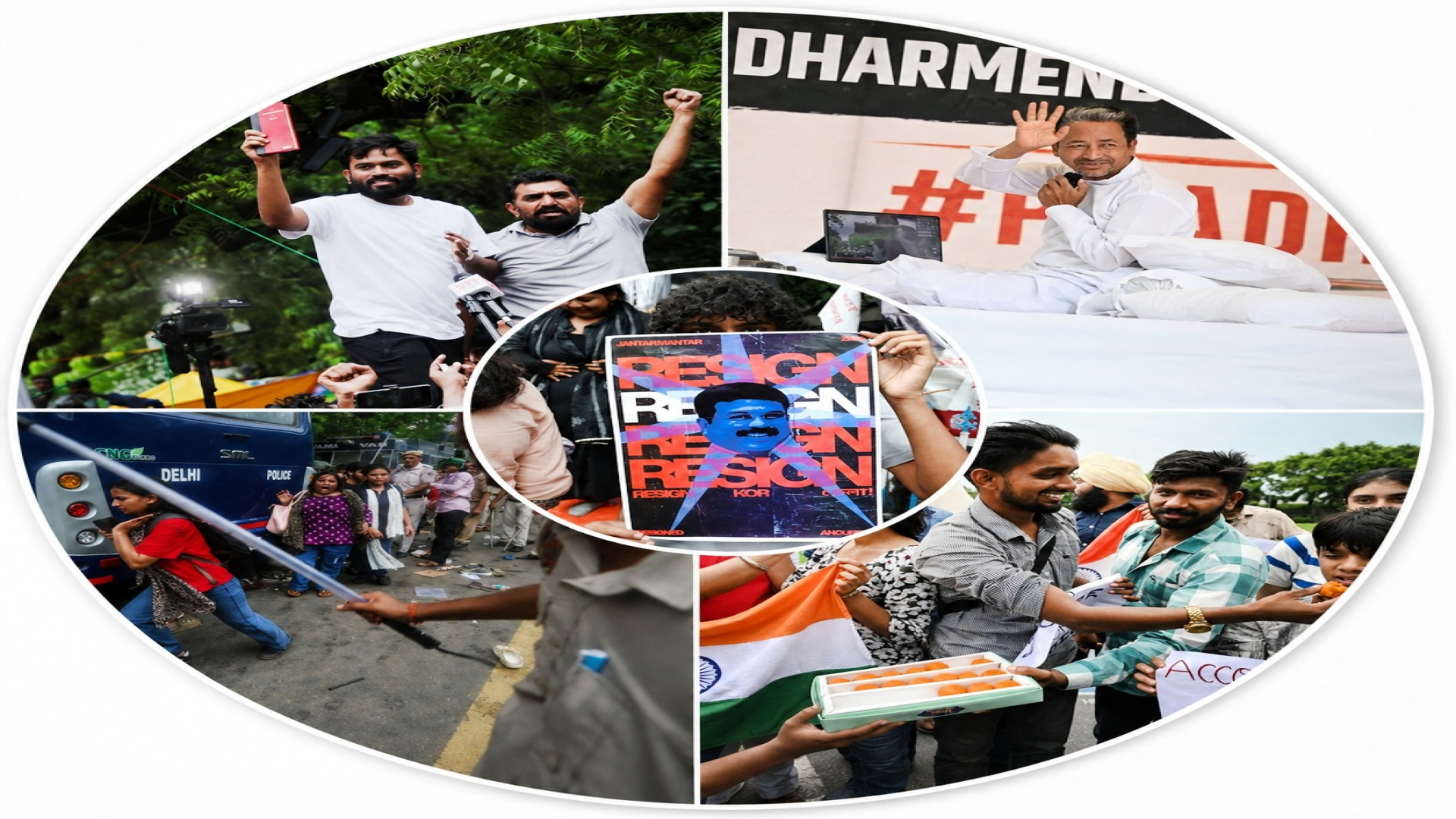
PANAJIIndia's Education Minister, Dharmendra Pradhan, finally resigned on Saturday, and the country's youth claimed their first political scalp in a huge victory for their over-month-long protest, which began with the outrage over the leaked medical entrance (NEET) exam paper and eventually exploded into one of the largest student-led protest movements in recent history.The Cockroach Janata Party (CJP), born of satire and defiance, is now a national banner with which…


