


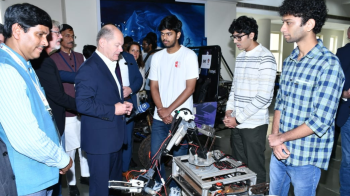
Panaji: Chancellor Olaf Scholz of Germany visited BITS Pilani in Sancaole on Saturday to discuss green and sustainable growth with students. This visit follows recent agreements between India and Germany to enhance their partnership in sustainable development, including the launch of the Green Hydrogen Roadmap in New Delhi.
Upon his arrival, Chancellor Scholz was warmly welcomed by the university's leaders, including Vice Chancellor Prof. V. Ramgopal Rao and Director Prof. Suman Kundu.
During his visit, Scholz held a Q&A session with the students, addressing important international political issues and the future of India-Germany cooperation. He highlighted the potential for Germany to assist India in its energy transition and emphasized the importance of collaboration in achieving a healthier and cleaner future.
The discussion focused on key areas such as youth representation, innovation opportunities, and the significance of education and skills training, particularly in relation to start-ups.
Chancellor Scholz also took time to view four innovative projects created by BITS Pilani students. He interacted with teams from various clubs, including:
Society of Automotive Engineers: Students Shardul Tomar, Nilay Wani, and Kunal Warat presented their electric vehicle project, Team GigaWatt, and an all-terrain vehicle project, Team Grease Monkeys.
Project Kratos: Students Vyomesh Bhatt, Akash Bhosale, and Kaustubh Saoji explained their work on this project, which involves over 50 students working on subsystems like Mechanical, Controls, and Electronics.
Electronics and robotics team: Ajinkya Deshpande, Vimarsh Shah, and Ansh Parmeshwar introduced their campus initiative focused on hands-on engineering and robotics.
Aerodynamics club: Adarsh Pai and Raghav Mohan Kumar discussed their achievements in aviation competitions and research projects aimed at addressing urban mobility and agricultural surveillance.
Space tech club: Avichal Verma presented their projects on rocketry, CANSAT, and HERC, which include contributions to scientific data and public outreach.


