


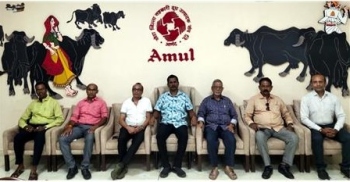
 The delegation led by Goa Khadi and Village Industries Board Chairperson and Cortalim MLA Anton Vas to Gujarat to study successful models of rural industry and co-operative ventures.
VASCO
Chairperson of the Goa Khadi and Village Industries Board and Cortalim MLA Anton Vas led a delegation of board members to Gujarat this week to study successful models of rural industry and co-operative ventures.
The team visited the Gujarat Khadi and Village Industries Board, the Gujarat Village and Industries Commission, and the iconic Amul Co-operative Dairy Society to understand their functioning and explore the possibility of replicating similar initiatives in Goa.
The visit aimed at gathering insights into schemes and practices that have empowered rural communities in Gujarat, particularly in the sectors of Khadi, village industries, and dairy co-operatives.
These institutions are widely acknowledged for transforming local economies, generating employment, and sustaining traditional skills while blending them with modern market needs.
At the Amul headquarters, the delegation observed first-hand how a co-operative movement, driven by farmers and managed with accountability, has grown into a globally admired success story. The Amul model not only revolutionised India’s dairy sector but also stands as an example of how collective ownership and transparent governance can uplift thousands of families.
Speaking after the visit, Vas said Goa could greatly benefit from adopting and adapting such models.
“This is a system which, if diligently implemented in Goa, can elevate economic levels and provide livelihoods to our people,” he remarked.
Vas emphasised that Khadi and village industries have the potential to empower Goan artisans and self-help groups, while a robust co-operative framework could transform small-scale enterprises into sustainable ventures.
The Goa Khadi and Village Industries Board now plans to prepare a roadmap based on the learnings from Gujarat.
Officials said pilot projects, particularly in rural and semi-rural pockets, will be explored in the coming months to assess feasibility and encourage wider participation from local communities.


