When Fr Bolmax Fidelis Pereira arrived in Chicalim in 2019, he found a village ” quiet, picturesque, and largely disengaged from the storms gathering around it. When he left this world early Tuesday morning, he left behind a community transformed ” its youth mobilised, its elders re-energised, its voice loud, clear and unafraid.
That transformation was not accidental. It was the deliberate, tireless, and inspired work of one extraordinary man.
Fr Bolmax was no ordinary parish priest. He held a PhD with research centred on the Wetlands of Goa and served as Assistant Professor at St Joseph Vaz College of Science and Commerce ” a man equally at home in the lecture hall, the paddy field, the protest march, and the pulpit. As convenor of the Diocesan Commission for Ecology of the Archdiocese of Goa and Daman, he carried the Church's moral authority into the most pressing civic battles of the day. But it was at the village level ” in Chicalim ” where his most enduring and intimate revolution was quietly forged.
Walking into history, walking into purpose
Fr Bolmax's transformation of Chicalim began not with manifestos but with footsteps. Through his association with the Chicalim Bio-Crusaders, he participated in two landmark heritage walks that would reshape his understanding of the village and, in turn, reshape the village itself.
The first was the 'Walking With The Caveman' ” a journey through Chicalim's prehistoric and historical soul, from the megalithic pit-dwellings of Naquelim through the khazan lands, tracing the layers of human habitation and memory.
It was during this walk that Fr Bolmax discovered a landmark that would ignite a spiritual revival ” the ruins of the first church built in Chicalim, dedicated to St Bartholomeu in 1626.
The second walk, the 'Walk of the Pearl' ” a journey through the village's maritime heritage, its islands, and its ecological significance ” deepened his knowledge of Chicalim's interconnected past and present. These walks were not tourism. They were acts of retrieval, pulling back the curtain on a village's own buried narrative.
Reviving four centuries of faith
What Fr Bolmax saw in those ruins of St Bartholomeu's Church was not merely historical ruin but spiritual opportunity. He launched a deliberate and passionate revival of devotion to St Bartholomeu within the parish ” awakening within Chicalim's parishioners a sense of continuity with their ancestors, of unbroken faith across four centuries.
This initiative culminated, last year, in a year-long celebration marking 400 years of devotion to the faith ” a parish-wide commemoration that drew the community together in thanksgiving for their spiritual heritage.
Igniting the youth
Armed with this deeper understanding of Chicalim's history, heritage, and spiritual roots, Fr Bolmax moved swiftly and creatively to engage the village's greatest untapped resource ” its youth. He founded the Chicalim Youth Farmers Club, a pioneering and deeply counter-cultural initiative that drew young people ” many of whom had never considered agriculture as anything but a relic of the past ” back to the soil. Through this club, he reframed farming not as a burden but as an act of identity, ecology, and pride. It was a radical reimagining of what young Goans could aspire to.
Blessing of pets
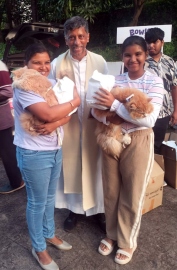
He introduced pet blessings at the parish ” a joyful, inclusive tradition that may have seemed small but was, characteristically, a deliberate act of community building, drawing families together in celebration of the life around them. He understood instinctively that culture, faith, and ecology were not separate chapters but a single, continuous story.
Building protest into an art form
When the devastating plans for the railway double-tracking through Mollem forest came to light ” threatening the irreplaceable biodiversity of one of Goa's last great green lungs ” Fr Bolmax did not merely sign petitions. He trained Chicalim's youth to protest through dance, transforming their grief and anger at the forest destruction into a powerful, expressive public movement.
He then organised and led the walk from Mollem to Vasco ” a bold public act designed to draw attention to the double-tracking project and the catastrophic felling of trees in the Mollem forest area.
Voice at every table
Fr Bolmax understood that environmental protection required presence ” at every forum, at every level. He was a regular and active participant at Gram Sabhas, engaging deeply in village development and planning activities and ensuring that Chicalim's ecological concerns were never absent from the democratic conversation.
He also stood firmly against the overextraction of oysters, clams, and haddes from Zuari Bay, rallying the community to protect the delicate estuarine ecosystem that generations of Chicalim families depended upon.

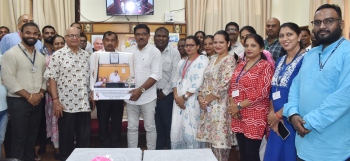
Fr Bolmax Pereira along with the Chicalim BioCrusaders.
When submissions were needed for the Margao public hearing on Coastal Regulation Zone guidelines, he went further than most ” he asked that Chicalim's young people be trained to present the arguments themselves. Through the Chicalim Bio-Crusaders, those young voices learned to stand before authorities and speak with data, conviction, and courage.
Reviving a forgotten heritage
Among Fr Bolmax's most culturally significant contributions was his wholehearted championing of the 'Parkonnem ” Kitem Tem Sang' competition ” a celebration of the ancient Konkani tradition of riddles, or Parkonnem, a linguistic and cultural heritage quietly fading from memory.
The competition was conceived and introduced under the Chicalim Bio-Crusaders, but it was Fr Bolmax who saw its potential beyond the village and carried it across Goa with his characteristic energy and reach ” giving it a platform, a visibility, and a momentum it could not otherwise have achieved.
Turning a village into a movement
Fr Bolmax was, above all else, a man who believed that ordinary people ” especially the young ” could do extraordinary things if someone simply believed in them first. He took a sleeping village and turned it into a movement. He took its youth and turned them into warriors ” of the soil, of the sea, of the stage, and of the street. He took its forgotten saints and brought them home. He took its history and made it live again.
The village he leaves behind is louder, prouder, more faithful, and more alive because of him. Chicalim will not forget.
(Cyril A. Fernandes is the President of the Goa Catholic Association and of Chicalim Bio-Crusaders. He lives in Chicalim at Alto-Chicalim.)