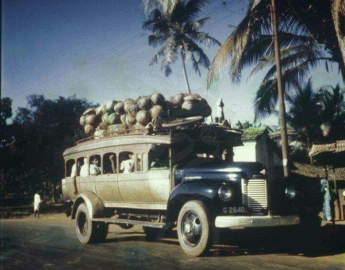
It's easy to lapse into nostalgia. We in Goa are great at this. Just the other day, I saw a photo on the cover of a Konkani magazine (this is not a personal criticism of the mag), which showed a family standing before an old-style carreira (traditional Goan bus). The title above it read: "Adlea Goykaranchem Susegad Jivit". Or, the relaxed life of the Goans of the yesteryears.
Now, this might sound convincing. The family of four seems equally relaxed, and not part of the rat race. There's even a khaki-clad driver, obviously waiting and posing for a photo between trips. There are coconut trees in the background, adding to the scenic picture of the Goa in the 1970s.
A picture postcard image, right? Wrong.
And how could I be so confident to that answer? Because I myself am the smaller boy in the photo. The photo happens to be of my family (shot by an uncle, visiting from Southampton, and using a Polaroid camera) around 1973 or 1974. It was clicked in Colvale, Bardez, while on a family visit to an elder relative there.
At the time we were supposed to be living the "peaceful life", things were actually quite tough in Goa. Jobs were hard to come by and so was transport (in a way, it is the same now too). Health facilities were limited, though some doctors were skilled and perhaps less money-minded then. Education facilities were limited; even if our youth still lack what they need. Children often stayed in boarding school in those times. Homes were available on rent, but things changed after the tenancy laws upset that equation.
In the throes of the end of Portuguese rule in Goa, there was still a lot of uncertainty prevailing. The political situation was at times chaotic. Merger and language were being fought over. Lifestyles that people had become used to for long were getting unsettled. In the 1960s too, many Portuguese-speaking Goan Catholics particularly were still leaving Goa amidst the political and other uncertainty.
So why do we have this tendency to see the past as a better place than now? There was a lack of infrastructure, of facilities, of jobs. In the 1960s and 1970s, even food and basics were sometimes hard to come by. Parts of India had then recently gone through famine. For food, the country depended on imports from abroad. We considered ourselves lucky if we got the ration supplies (rice, oil, sugar) on time. People heaved a sigh of relief if they procured all their "rations" at one lot, and didn't have to make another trip to the 'fair price' shop.
Education was not as widespread. Till roughly 1970, much of rural Goa did not have electricity power supply. Roads were limited in reach and quality. Water supply didn't reach one's home, though there were wells in many areas to depend on.
Even the earlier decade had been tough. The Indian blockade of Goa had put the region to hardship. Some students remember how they would go for their SSC exams to Poona in the north via the Karwar border in south Goa. The Portuguese attempted to shore up local essential supplies by importing the same from Europe and elsewhere.
Goa was still a migration driven economy. Its best and the brightest left its shores. Those left behind often depended on remittances (and the Money Order economy, as it has been sometimes described). Of course, this still continues, though in a changed way. Goa became a "fashionable" address to live in, sometimes after the 1990s. This was the case both among people from other States, and expat Goans (even those in Bombay) who thought of a return. In a word, life was not easy at that time.
There are other reasons given for why we might prefer to remember the "good old" bad days, with rose tinted glasses. "Rosy retrospection" is the term given to describe why we might judge the past as being far more positive than the present. "Declinism" is the tendency to believe that "things were better in the old days" or to use terms like "back in my day".
Of course, this does not imply that we are all moving towards some golden dawn. Maybe the simpler, satisfied lifestyles of the past are a thing we can never hope to achieve again. Villages could sustain lifestyles; now these have become mass dormitories. Our clean, if simple, environments seem to have given us less cancers and illnesses of affluence (though many more succumbed to shortages).
Human relations were probably of a different quality, and what we didn't have in material terms, we probably made up for through quality of relationships. Before our rivers and seas got over-mechanised, our seas were plentiful in fish in the markets. Our tougher lifestyles simply made us healthier.
Today, dismissing the past and rubbishing it has also become a political tool. By pointing repeatedly to the "bad old days", an attempt is made to justify whatever is done in our times. For instance, the slaughter of the environment, controversial projects, overspending, creating debt for unborn generations, and so on.
Even while we need more realistic understandings of the past, we can't afford to go in for a wholesale blackening of our yesteryears. Every new regime wants to show that it is a marked improvement on the past. But we know this is simply not true.
To overcome excessive nostalgia, or needlessly creating Black Legends, it is time to be more balanced in understanding our past and present. By being less than honest, we risk bluffing only ourselves.