Last week, this column looked at how social initiatives in Goa across the decades, and centuries, have added value to the State. In more recent times, some social media networks have been playing this role. Among the not-for-profit, voluntary and community-based initiatives we looked at were Goan kudds (or residential village clubs) in cities outside Goa; clubs or institutes in East Africa and elsewhere; parish, temple or village associations; community halls; music networks; sport and youth clubs; alumni networks; expat Goan associations; and online networks.
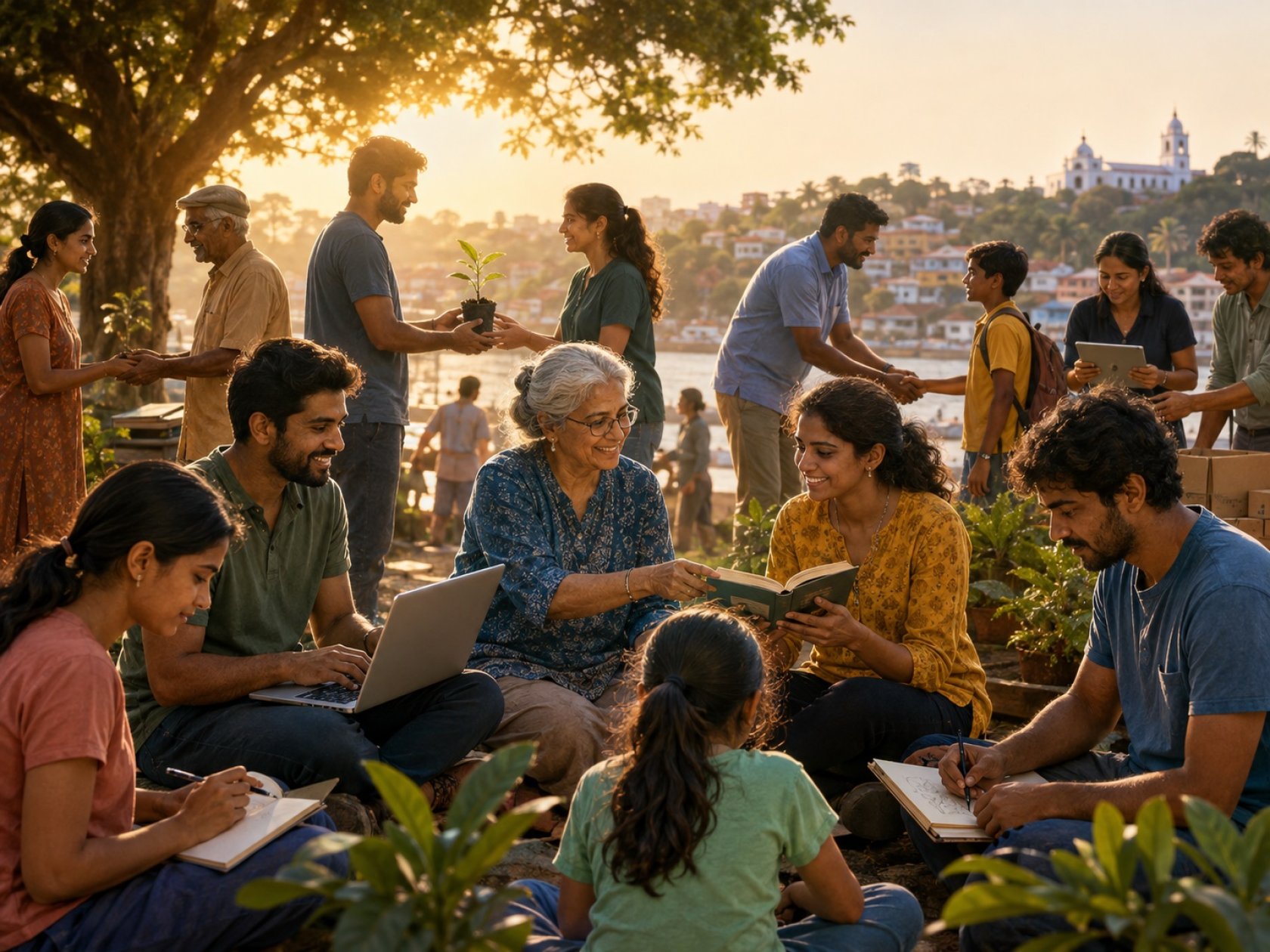
To take this argument forward, this time, let’s look at how those who benefit from publicly shared knowledge, networks and resources could act in a way that sustains these initiatives. What is the best way to ‘pay forward’ and ensure that we keep such institutions going and growing? There is a lot of giving and generosity happening both in the online world and the real world. The Commons (public mailing lists, discussion groups, community archives, open databases, freely shared knowledge, public events, volunteer networks and the generosity of individuals) belong to everyone.
These initiatives are sustained by the willingness of people to give as well as to receive. They thrive only when those who benefit from them recognise that access is not just a right but also a responsibility. Here is a tentative attempt to build a Charter that suggests a simple ethic for everyone who draws upon the Commons. The aim: to strengthen Goa’s long tradition of sharing, mutual aid and generosity.
1. Share as freely as you take. If you receive knowledge, information, contacts, opportunities or assistance freely from the Commons, please make a genuine effort to contribute something back. Take freely, but give freely too. The Commons should not become a one-way resource from which some continually extract while others continually provide.
2. Pay forward what you receive. When someone helps you, do not feel obliged merely to repay that particular person. Instead, pass the benefit onwards, to someone else in the future. If someone gives you an introduction, share another useful contact with someone else. If someone teaches you something, teach another. If someone opens a door for you, help someone else find a door. In this way, generosity multiplies rather than merely changing hands.
3. Keep public things as public as reasonably possible. Events, talks, lectures, discussions and cultural programmes organised with public support should be open and accessible to the wider public whenever possible. So should public knowledge and community resources. If registration, capacity or costs make it tough to do so, organisers can work to share recordings, transcripts, summaries or other material afterwards.
4. Don’t turn the Commons into a private toll gate. A toll gate implies a checkpoint on a road or bridge where drivers stop and pay a fee for using the route. Information got through public or community networks should not be unnecessarily locked away, monetised or restricted.
5. Acknowledge the people who make the Commons possible. Give credit where credit is due. Acknowledge the person who supplied the information, made the introduction, preserved the archive, organised the event, created the resource or contributed the expertise. Often, people are happy if they are just recognised; they don’t expect more.
6. Share opportunities, not just information. If the Commons brings you a job, commission, grant, invitation, fellowship, platform or other opportunity, remember those who helped you to get to it. Share opportunities, especially with those who may have fewer connections or less access than you.
7. Help newcomers enter the circle. Don’t create an exclusive club. If you benefit, make sure to also welcome newcomers, explain unwritten rules, answer reasonable questions and help others find their footing.
8. Contribute according to your means. Not everyone can contribute money, time or expertise. Be generous according to your capacity.
9. Don’t hoard what can be shared: Knowledge, contacts, historical documents, photographs, recordings and research often become more valuable when shared. True, there can be restrictions of copyright or privacy. What is preserved and shared today may become part of the cultural memory of tomorrow.
10. Preserve and improve what you inherit: The Commons is not merely something we consume; it is something we inherit and pass on. Keep records you have accurate, useful and alive. Correct errors, add information, document sources and, where possible, help maintain the infrastructure that sustains it. The experiences of the Free Software and Open Source movements in Goa are worth learning from.
11. Give without keeping score: The spirit of the Commons is weakened when every act of generosity becomes a transaction. Give because you can. Generosity shared through a community benefits everyone.
12. Respect the Commons even when you disagree. Debate vigorously, but do not misrepresent, harass, intimidate or silence others. Knowledge can be contested without relationships being destroyed.
13. Make your contribution useful to those who come after you. Leave information in a form that others can find, understand and use. Properly label documents, preserve sources, record oral histories, provide context and avoid needless barriers to access. Today’s contribution can become tomorrow’s foundation.
14. Remember that generosity creates abundance: The more we share, the more there is to share. By sharing, we do not lose knowledge. When we introduce two persons, we create a new connection. Opening an event expands the community. Sharing an archive preserves memory for generations.
15. Leave the Commons richer than you found it. Ask: “What can I do to strengthen this for the next person?” When many contribute, the Commons becomes self-renewing.
In short: Share with generosity. Pay forward with trust. Give credit freely. Open doors for others.
This suggested charter is not a set of enforceable rules but a social compact. It is an invitation to cultivate a culture in which knowledge, opportunities and goodwill circulate freely. After all, what we have is not always ours alone. A helping hand creates an obligation to extend another. Furthermore, a community becomes stronger when generosity is passed forward rather than kept within closed circles.
(The writer, influenced by the Free Software and Open Source world, has taken that spirit to other online fields in Goa....and beyond)