Being in between two book related days (Aug 9 and 12), maybe its apt to do a realistic stock-taking of where Goa really stands on the book front, its actual potential, and also all the hype we've been receiving for such a long time.
Goa's link with the printed word cannot be overemphasised. We often forget that our tiny region was home to the first (Gutenberg) printing press in Asia, way back. That was almost five centuries ago. Will we be celebrating that date in two decades time, or just forget our history, as we are mostly wont to do?
In today's Goa, the book is still culturally important. Especially when the printed word tells the stories of the people of this small land. While many authors still feel they don't have enough readers or appreciation, the opposite is also true. You can still find people desperate to find the book they want, rue the fact that it's out of print, or struggle to find some place at which to get it.
Yes, the book is today in a complicated and competitive space. Thanks to technology, and shifts in economics (which make small print-runs possible), book publishing has grown in diversity.
Goa continues publishing in English, in Konkani (both scripts), in Marathi and occasionally even in Portuguese. This is possible due to the efforts of local publishers, writers, libraries, literary organisations, bookshops and readers of course.
Independent publishers, self-published authors and small organisations have helped bring out works on Goan history, culture, language and society that might otherwise struggle to find a commercial market.
Yet, at the same time, reading habits have been affected by smartphones, social media, video platforms and the general shift towards digital consumption. Konkani remains divided by script and language-market issues.
The physical book hasn't disappeared. Local history, memoir, fiction, poetry, cookbooks, cultural studies and books documenting Goa continue to find readers. People are keen to preserve memories and understand a fast changing society.
We do have challenges to find sustainable ways to publish, distribute, sell and encourage reading in a small market facing tough competition for people's limited attention.
Nobody disagrees that books need to be promoted. A good book can forever change your life. It is your teacher and guide.
If there's one simple, inexpensive tool that promotes life long learning, it's the book. Likewise, you can travel the world, move across centuries, and encounter so many things through simple pages.
Educationists and governments also agree wholeheartedly about the need to promote reading. Librarians have a stake in doing so. Yet, little happens where it really matters.
Favouritism and corruption can undermine even some of the more laudable efforts to promote books and reading. Someone I know recently described how he was losing his job because the organisation he worked for had been deprived of its tax-deduction benefits and, consequently, was being cut off from its source of corporate funding.
In this context, individuals who care should take up the task of promoting the printed word. Small, regular actions can promote a book culture, without relying only on government or literary institutions alone.
Buy at least some books from local authors and publishers; give books as gifts; borrow and exchange books; encourage children to read beyond textbooks; organise neighbourhood, school and community reading circles.
You can also invite authors for informal discussions; support local bookshops and libraries; donate good books to village libraries and schools; and write reviews or recommend Goan books on social media.
There is also a strong case for buying and reading books in Konkani, Marathi and Portuguese as well as English; the smaller languages feel the most pressure. Helping sustain Goa's multilingual literary culture is important.
Writers and readers can collaborate on e-books, audio-books, podcasts and online reading groups. Elders can record and publish family memories, oral histories, recipes, folklore and village histories before they disappear.
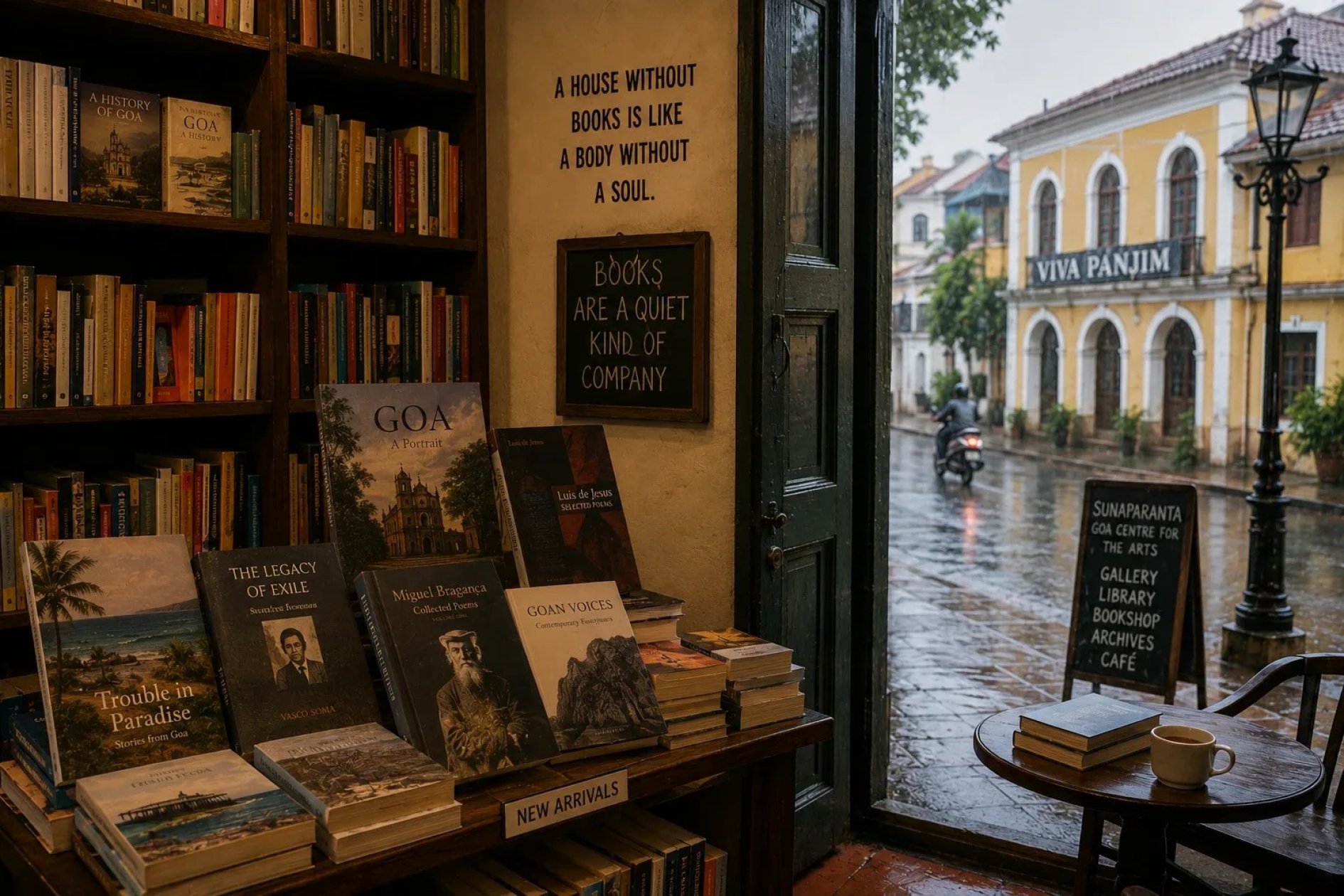
Libraries can become active community spaces rather than merely places where books are stored. Many restaurants along the coastal belt are trying this out; even if their motives are commercial too. So are book shops like DogEars, Broadway, Literati, and Carpe Diem, among others.
Could we not think of 'class libraries' in schools, where every class has its own collection of pre-owned books? Children can exchange their books with one another, taking one home for everyone they bring in. At our Mapusa school in the 1970s, one of the innovative teachers actually tried out something like this.
Schools can give reading a place outside the examination timetable. Even in their crowded timetables, maybe some could try to set aside even just 15–20 minutes of daily or weekly free reading.
At least two schools one knew tried to keep a free-to-read collection of magazines and books at some central point. Students can be encouraged to review books, and meet local authors or illustrators.
Schools can intentionally stock books about Goa and by local writers, in all languages, to go beyond prescribed textbooks. Stories that children write can be crafted into modest 'chapbooks'.
Parents can be involved through book fairs, second-hand book stalls and “bring a book, take a book” schemes. Most importantly, schools and libraries can create their own modest book budgets (even a few hundred rupees per month) and collectively purchase directly from local publishers and authors. A library that is active, visible and welcoming can generate its own reading community; it need not wait for a government programme to tell people to read.
Aug 9 was Book Lovers' Day, globally. Across India, Librarians' Day was on Aug 12, in honour of SR Ranganathan, whose contribution to the field is vast and worthy of study by all interested. Everyone can indeed do something to build this deserving field.