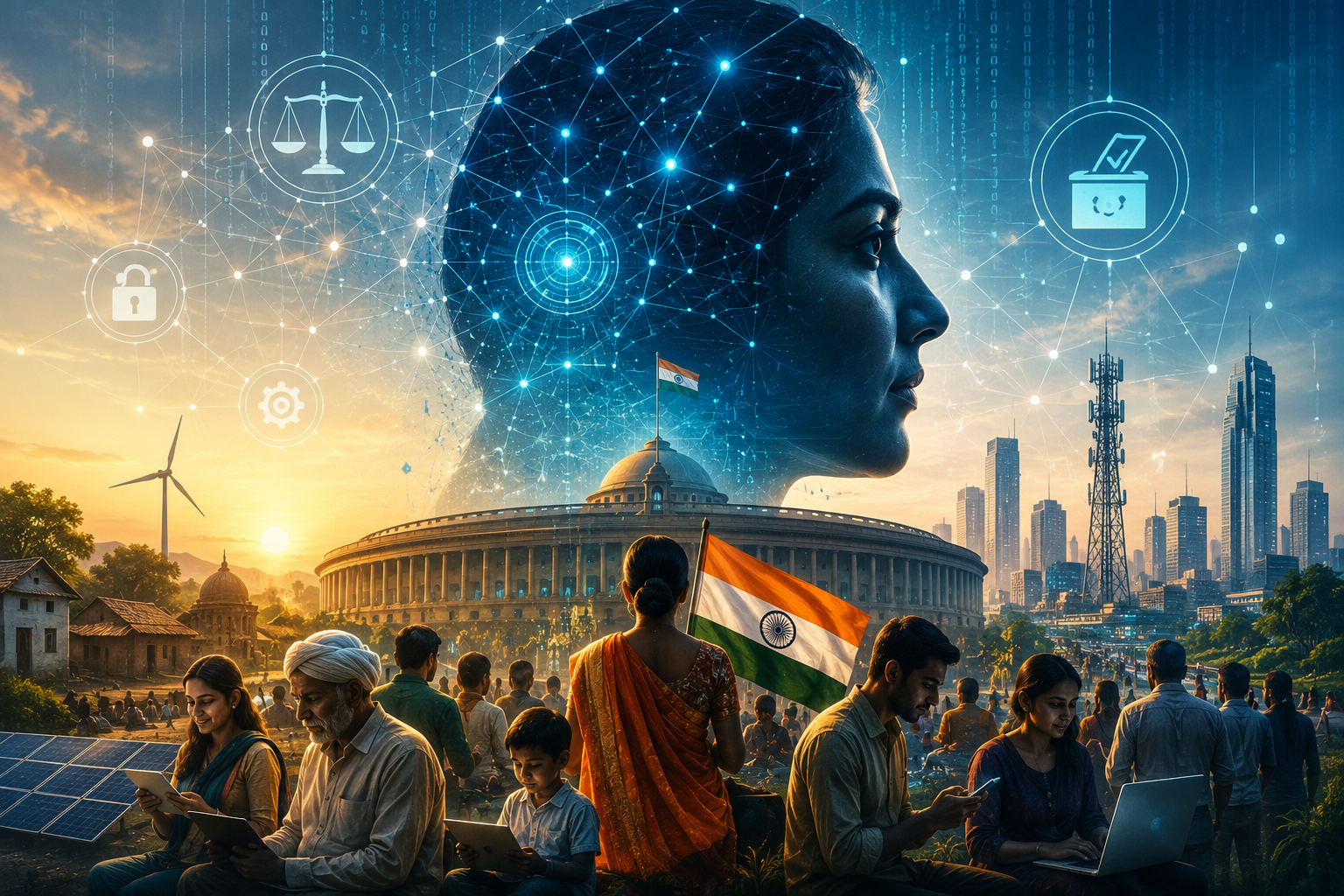
Artificial Intelligence is rapidly reshaping societies across the globe. From determining access to credit and employment to influencing political discourse and national security, digital technologies have become deeply embedded in everyday life. For India, home to more than 1.4 billion people and one of the world’s largest digital populations, the challenge is no longer whether it should regulate Artificial Intelligence and digital platforms, but whether it can do so while protecting democratic values and encouraging innovation.
The framework proposed by Shashi Tharoor in The Hindu (June 29, 2026), centred on rights-based governance, democratic accountability, protection of free speech, media literacy, and national security, offers a compelling roadmap. However, implementing such a vision in a country as vast, diverse, and politically complex as India remains a formidable challenge. The larger question is whether India can achieve this balance and what is at stake if it fails.
The first challenge is protecting citizens’ rights in an increasingly data-driven society. India’s digital revolution has been remarkable. Initiatives such as Aadhaar, UPI, and Digital India have transformed governance and financial inclusion. However, they have also generated enormous amounts of personal data, raising concerns about privacy, surveillance, and misuse.
India has taken important steps through the Digital Personal Data Protection Act, 2023. Yet concerns remain over enforcement, institutional independence, and the balance between state interests and individual rights. A rights-based AI ecosystem will require more than legislation. It will need strong institutions, independent regulators, transparent processes, and a judiciary capable of responding effectively to digital rights violations.
The second challenge is ensuring accountability of large technology platforms. Social media companies have become modern public squares, but their algorithms often prioritise engagement over accuracy, amplifying sensationalism, outrage, and misinformation. In India, false information spread through digital platforms has contributed to communal tensions, mob violence, and political polarisation.
Regulating these platforms is complex. Most major technology companies operate across multiple jurisdictions and possess vast financial and technological resources. Excessive regulation could discourage innovation and investment, while weak regulation could allow harmful content to spread unchecked. India must therefore create policies that ensure transparency and accountability without restricting technological progress.
Equally important is protecting free speech. Democracies depend on dissent, debate, and the exchange of ideas. Measures to combat misinformation must not become tools to suppress legitimate criticism or political opposition. The challenge is to distinguish harmful manipulation from genuine expression.
Deepfakes, coordinated bot campaigns, and foreign influence operations pose serious threats to democratic processes. However, regulating individual opinions or ideological positions would undermine constitutional freedoms. Digital regulation must therefore remain narrowly defined, proportionate, and subject to judicial oversight.
Another critical area is media literacy. Technology alone cannot solve the misinformation crisis. Citizens need the ability to navigate complex information environments. This is especially important in India, where linguistic diversity, different literacy levels, and uneven digital access create unique vulnerabilities.
Media literacy must become a national mission, helping citizens understand algorithms, misinformation, and manipulation.
Alongside this, India faces growing national security challenges as information warfare, driven by state and non-state actors, threatens elections, social harmony, and democratic institutions. Digital sovereignty is now closely linked to national sovereignty.
India cannot afford complacency. Sophisticated early warning systems supported by Artificial Intelligence, cybersecurity experts, fact-checking organisations, and civil society groups are essential to detect coordinated disinformation campaigns before they spread widely. However, these systems must operate transparently and protect civil liberties to prevent misuse as tools of mass surveillance.
Can India realistically implement this ambitious agenda? The answer is cautiously optimistic.
India has several advantages: a strong democratic tradition, a growing technology sector, world-class digital infrastructure, and a large pool of scientific talent. Its success in deploying digital public infrastructure demonstrates its ability to innovate at scale. Increasing public awareness about privacy, misinformation, and digital harms also provides momentum for reform. However, success will depend on political will, institutional integrity, and sustained public participation. Digital governance cannot remain the responsibility of governments and technology companies alone. It must involve academics, journalists, civil society groups, technologists, educators, and citizens.
There are also significant obstacles. Bureaucratic delays, regulatory fragmentation, political polarisation, and limited institutional capacity could slow progress. The temptation to prioritise short-term political interests over long-term democratic safeguards remains a concern. Moreover, technological change often moves faster than legislation, making flexible and adaptive regulation essential.
What is truly at stake is the future character of India’s democracy in the digital age. Weak protection of rights could lead to widespread surveillance and algorithmic discrimination. Unaccountable platforms could worsen misinformation and social divisions. Restrictions on free speech could weaken democratic debate. Poor digital literacy could leave citizens vulnerable to manipulation, while insecure information systems could allow external actors to exploit social tensions.
However, if India succeeds, it could offer the world a model of democratic digital governance that balances innovation with human dignity, technological advancement with constitutional freedoms, and national security with civil liberties.
The choices India makes today will shape not only its digital future but also the future of its democracy. The challenge is enormous, but so is the opportunity.
How India responds will determine how history remembers its journey into the age of Artificial Intelligence.