JOAQUIM GOES
A government reveals its priorities through what it builds, what it protects and what it expects its people to endure.
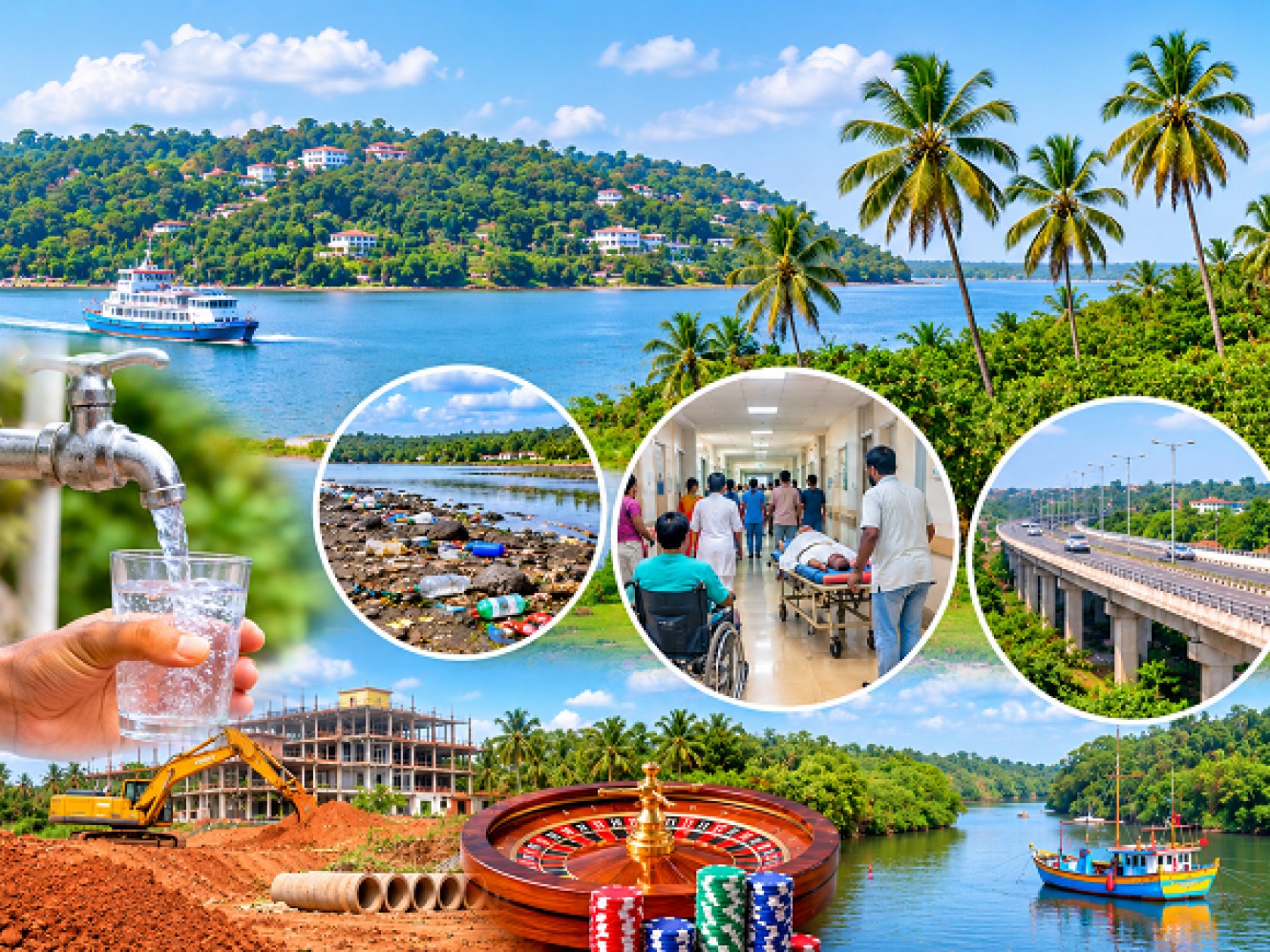
In Goa, consider the contrast. A new waterfront terminal receives crores of rupees, while a 500-year-old heritage palace across the road cries for attention. Patients wait for hospital beds. Technology ambitions attract publicity, while scientific warnings about contaminated waters are concealed under a mat. Infrastructure is inaugurated; its usefulness becomes a matter for adjustment afterwards.
These are connected failures of governance. They reflect a development model increasingly detached from the lives it is supposed to improve.
After fourteen years of BJP-led government, Goans are entitled to ask: where is the coherent vision, and where is the accountability for delivering it?
Smart-meter installations have been paused. The tender to operate the Captain of Ports terminal and allied jetties has been withdrawn, although a fresh tender is reportedly being prepared. Reconsideration can be welcome. But citizens deserve to know what has changed in the government’s thinking, beyond the timetable.
A controversial decision postponed remains a decision awaiting scrutiny. As elections approach, the public must distinguish between a government correcting its course and one simply moving difficult questions beyond polling day.
SUCCESSION OF ANNOUNCEMENTS
The larger problem is that Goa’s future seems to arrive as a succession of announcements.
Spiritual tourism. Medical tourism. Artificial intelligence. Technology and data centres. Each deserves consideration on its merits, but a credible government would explain how these ambitions fit together, what resources they require and how they will create lasting opportunities for Goans.
Where are the published assessments of water demand, electricity supply, land availability, workforce needs and public benefit? Until now, all we have seen under this government is thriving cybercrime, drug peddling and shady spa and nightclub industries.
A state must understand its capacity before promising it to investors. Medical tourism makes the contradiction particularly stark. Before inviting more people to seek treatment in Goa, the government must ensure dependable access for those who already live here. Recent reports from South Goa District Hospital described patients receiving treatment on chairs, wheelchairs, stretchers and even the floor after demand exceeded available beds.
That is a failure of capacity planning for which patients and medical staff bear the consequences.
POTENTIAL RISKS
Yet the health question begins well before anyone reaches a hospital. It begins in the water we drink, the air we breathe and the food we eat. It begins with sewage treatment, waste disposal, industrial regulation and planning permissions. Every department whose decisions affect these conditions carries a public-health responsibility.
Research in the Mandovi and Zuari estuaries has documented microbial pollution and antibiotic resistance among pollution-indicator bacteria. The findings identify potential health risks and make a compelling case for controlling contamination at its source.
A separate study of edible bivalves and crustaceans in the Mandovi reported concentrations of several metals, including mercury, above the permissible limits used by researchers. These findings concern sampled organisms and locations; they warrant systematic monitoring, clear public advice and investigation of pollution sources.
The responsible response is neither panic nor reassurance through press releases. It is to publish the evidence, identify discharges, enforce the law and demonstrate improvement.
Goa cannot afford a system that neglects preventable environmental risks and then asks crowded hospitals to absorb the consequences. These studies do not establish the cause of particular hospital admissions. They establish why prevention must be central to government. The same principle applies to coal handling and transport around Mormugao.
Residents have been raising concerns about dust pollution. The pollution control board has stated that no additional coal-handling capacity had been permitted, while port authorities maintain that operations comply with prescribed norms. Such assurances must be tested through accessible monitoring, independent scrutiny and effective enforcement. Any proposal to expand capacity must account for cumulative effects on surrounding communities.
For Goa, water security makes these choices even more consequential. The Mhadei must be defended through sustained legal, scientific and administrative work. The government’s recent accusations against Congress do little to answer the public’s fundamental question: what measurable protection is being secured for Goa’s water future?
The argument over casinos requires the same honesty. Congress must answer for decisions taken under its rule. The present government must answer for the permissions granted for new casinos, renewals and policies it controls today. Fourteen years is ample time to establish a record of one’s own.
AUDITING INFRASTRUCTURE
Infrastructure deserves an equally rigorous accounting.
Changes to access arrangements and restrictions on the Porvorim elevated corridor raise legitimate questions about how thoroughly local journeys were considered. Good engineering must serve communities around a project throughout its working life.
On Panaji’s waterfront, the Rs 48.87-crore Captain of Ports terminal should be judged by its demonstrated public value. Its scale and cost make the question unavoidable: could the same resources have met more urgent needs, and how does the building respect its historic setting?
Goa’s historic places deserve sustained care within that calculation. Heritage is part of the state’s living economy and collective inheritance. Allowing it to deteriorate while commissioning expensive new landmarks reveals a troubling hierarchy of priorities.
Meanwhile, citizens wait for files to move. The chief minister’s recent criticism of obstructive staff, including some peons, raises a question about leadership itself. If departmental supervision has failed, responsibility extends upwards. A functioning administration requires clear deadlines, traceable decisions and consequences for delay.
The same demand applies to policing, recruitment and public spending. Citizens need protection from fraud and violence, fair access to employment and an intelligible account of where their money goes.
Goa has the talent, institutions and natural advantages to pursue a better course. That course would connect environmental protection with public health, investment with local careers, infrastructure with daily needs, and heritage conservation with economic opportunity.
It would give citizens evidence by which to judge progress.
After fourteen years, repeated disorder cannot be explained away as an inheritance. Blaming Congress will not clean a river or provide a hospital bed. Announcing another project will not establish that the previous one served its purpose.
The question is larger than whether this government can win another election.
Is this the Goa we aspire to—and how much longer should its people be asked to wait for something better?
The writer is professor at Columbia University in the USA who hails from Cortalim