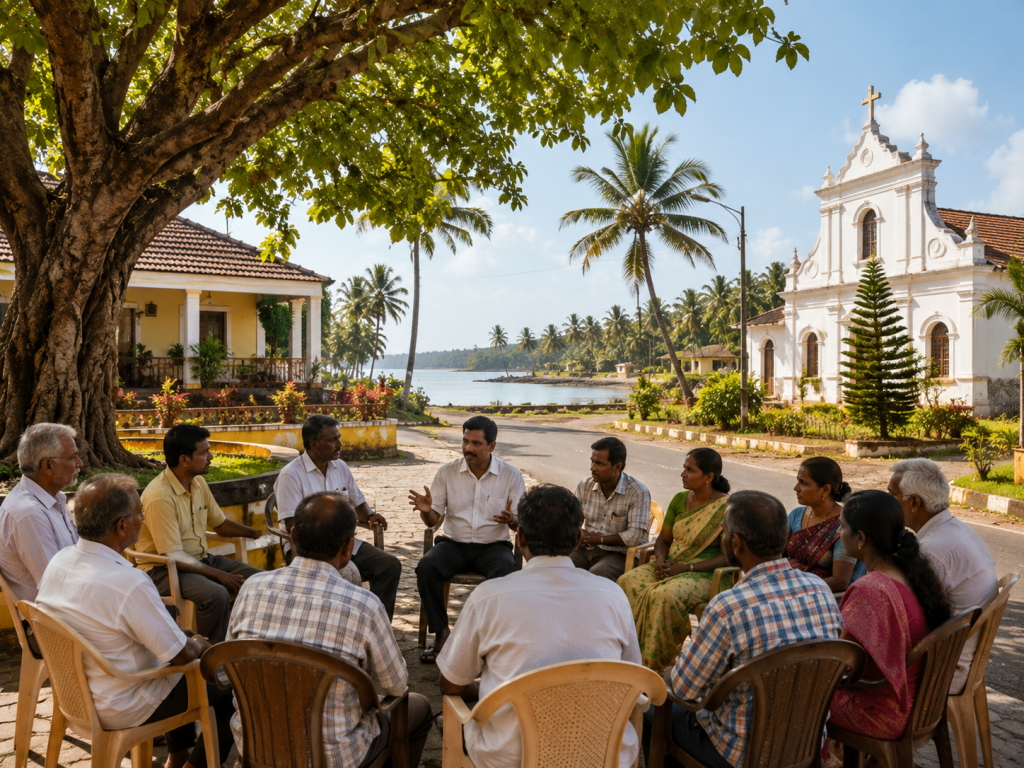
There is something about governance in Goa that most of us have accepted without ever questioning it. A road develops potholes after the monsoon. A drain remains clogged despite repeated complaints. A streetlight stays dark for weeks. The village market needs repairs. The football ground where children once played is neglected. Garbage continues to pile up at the same spot. We complain, discuss it over tea, post photographs on social media and visit the Panchayat office. Then someone says, “Let’s meet our MLA.” Everyone nods because it sounds perfectly normal. But have we ever stopped to ask why? Why should an MLA, elected to legislate for the entire State, become the person we approach to repair a village road, clear a drain or replace a broken streetlight? Shouldn’t many of these issues be resolved much closer to home?
These questions came to my mind after reading the Government of India’s Status of Devolution to Panchayats Report 2024, in which Goa ranks 16th among 18 General Category States. The headlines focused on Goa’s ranking, but the real story lies elsewhere. Before debating whether the ranking is good or bad, we must first understand what the report is measuring.
The report measures devolution—a word rarely used in everyday conversations but one that affects the daily lives of every Goan. Simply put, devolution means transferring powers, finances, responsibilities and administrative authority from the State Government to Village Panchayats. Introduced through the 73rd Constitutional Amendment, it empowered States to transfer responsibility for 29 subjects, including drinking water, sanitation, village roads, health, agriculture, rural housing, social welfare and local development. The principle was simple: decisions affecting a village should, as far as possible, be taken by those who know it best.
To understand how seriously States have embraced this constitutional vision, the Ministry of Panchayati Raj measures devolution using six indicators. It examines whether States have created an enabling legal framework, transferred functions, provided adequate finances, placed sufficient staff under Panchayats, strengthened their capacity through training and ensured accountability through transparency and public participation. Together, these indicators show whether local self-government exists only on paper or functions effectively in practice.
Seen in this context, Goa’s ranking becomes more meaningful. The report is not judging whether Sarpanches are honest, hardworking or efficient. It is assessing whether Panchayats have been given the authority and resources needed to perform the responsibilities citizens expect of them. It evaluates the system rather than the individuals working within it.
One of the report’s most significant findings is that Goa ranks at the bottom in Functions. A Panchayat can function as a true local government only if it has sufficient authority to take decisions affecting village life. After all, who understands a village better than the people living in it? They know where flooding occurs, which roads have become dangerous, where footpaths are broken, which public spaces need attention and where drinking water remains irregular. Local knowledge has never been Goa’s problem.
The question is whether local institutions have enough authority to act on that knowledge without every issue passing through multiple layers of administration. Goa also ranks at the bottom in financial devolution. Responsibility without resources is simply expectation without the ability to deliver. Even the most committed Panchayat cannot repair roads, improve sanitation, maintain public spaces or respond quickly to local concerns if it lacks adequate financial autonomy. Citizens become frustrated because nothing appears to move. Panchayats become frustrated because they are expected to solve problems without having the flexibility to do so.
The report also highlights an area where Goa performs well. It ranks among the better performers in capacity building, indicating that elected Panchayat representatives are receiving training and support. This is encouraging because capable leadership is essential for effective local government. Yet it raises an important question. What is the value of investing in training if institutions are not equally empowered to apply that knowledge? Skills become meaningful only when accompanied by authority and resources.
Many of us have accepted a culture where local issues depend on MLAs and Ministers. Instead of empowering local institutions, we have normalised seeking intervention from higher offices for problems that should be addressed locally.
The conversation cannot end there because decentralisation is not only about governments transferring powers. It is also about citizens using the democratic spaces that already exist. Every village has a Gram Sabha where budgets are discussed, priorities identified and development plans debated. Yet attendance at many Gram Sabhas remains disappointingly low. Decisions affecting entire villages are often discussed by only a handful of residents. Later, when projects are delayed or priorities seem misplaced, frustration grows. Democracy cannot flourish if citizens become active only after problems emerge. It requires participation before decisions are made.
At the same time, empowering Panchayats should never mean giving them unchecked authority. Greater powers must be matched by greater transparency, stronger financial accountability, regular audits and active citizen participation. Devolution is not about reducing accountability. It is about bringing accountability closer to the people.
Perhaps that is the real message behind Goa’s ranking. The report is not asking us to blame governments or defend Panchayats. It is inviting us to reflect on whether we have truly embraced the idea of local self-government that the Constitution promised more than three decades ago. Governments must continue strengthening local institutions. Panchayats must earn public confidence through transparency and responsiveness. Citizens must actively participate in shaping the future of their villages.
There is another important point worth reflecting on. Stronger Panchayats do not weaken MLAs or Ministers. They strengthen governance itself. When local governments effectively handle local issues, legislators are free to focus on what they were elected to do—make laws, shape public policy and address challenges affecting the entire State. That is how a mature democracy is expected to function.
The next time a road remains unrepaired or a drain overflows, ask not only, “What is the Panchayat doing?” but also whether we have given Panchayats the powers, finances and responsibilities they need. Democracy is measured not only by the governments we elect, but by how much we trust communities to govern themselves.