MARGAO
A little over a year and a half ago, Union Minister for Road Transport and Highways Nitin Gadkari described Goa's highway expansion as an integral part of the ambitious Mumbai–Kanyakumari four-to-six-lane highway corridor, envisioned to ensure seamless and faster movement of traffic along India's western coastline.
As part of this mega infrastructure project, the Margao Western Bypass was commissioned more than a year ago, providing a dedicated corridor for National Highway 66 traffic and substantially easing congestion in Margao city by diverting through traffic away from its busy streets.
While the bypass has largely achieved its objective of reducing traffic within the commercial capital, motorists are increasingly voicing concerns over severe bottlenecks on the Nuvem stretch of the highway.
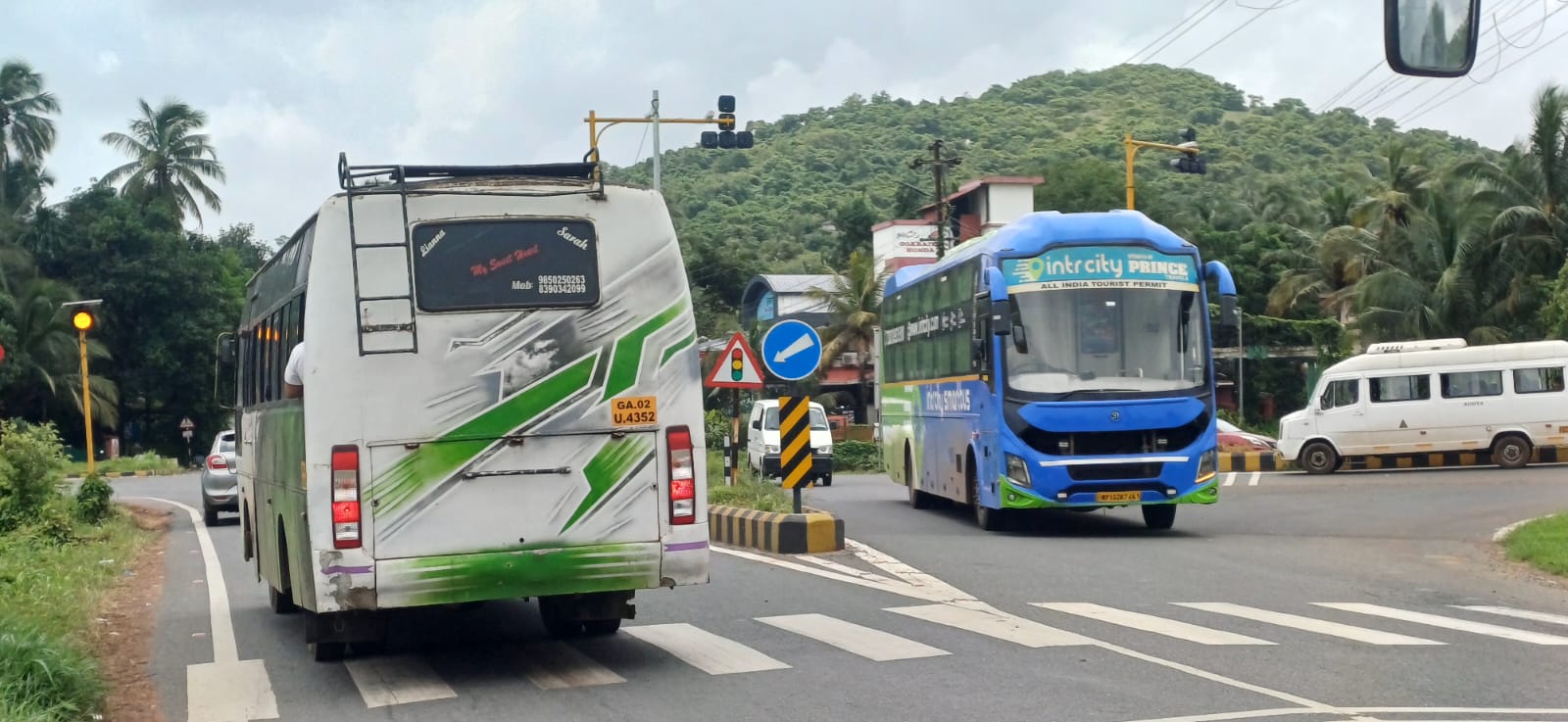
Ironically, the very road designed to facilitate uninterrupted highway travel has become a source of delays, with four traffic signals installed within a stretch of barely one kilometre.
The situation has sparked questions over the planning and design of the project, particularly why the National Highways Authority did not provide grade separators such as underpasses or road over bridges at key intersections, despite the bypass being part of a major national highway corridor expected to carry heavy traffic for decades.
Four traffic signals
starting at Gorvotti
The problem becomes evident soon after motorists enter the bypass near the wholesale fish market at Gorvotti. The first traffic signal is located at the Gorvotti junction itself, where vehicles heading south are required to take a right turn to join the bypass. Instead of facilitating a smooth transition onto the highway, motorists are forced to halt at the signal, creating delays from the very beginning of their journey.
Further ahead, after crossing the road-over-bridge near Nuvem panchayat, motorists encounter two more traffic signals in quick succession—one near Goa Ceramic and another near the Tata showroom. During peak morning and evening hours, these intersections witness long queues of bumper-to-bumper traffic, with vehicles often stretching several hundred metres as signal cycles struggle to cope with the increasing traffic volume.
The cumulative effect of these closely spaced traffic signals has significantly reduced the operational efficiency of the bypass. Many local motorists, particularly two-wheeler riders and drivers of light motor vehicles travelling short distances, now prefer using the old National Highway route via the Carmel college, instead of the bypass, defeating the very purpose for which the new highway was constructed.
Apart from the need to implement grade separators, social activist Savio Lopes pointed out that signals have also contributed to the problem along the stretch.
The bottlenecks have also raised broader concerns about long-term infrastructure planning. Critics argue that the highway authorities should have anticipated future traffic growth while designing a corridor that forms part of the Mumbai–Kanyakumari highway.