


 PANAJI
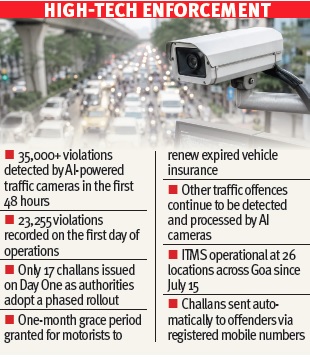
The newly deployed AI-powered traffic surveillance system has laid bare the scale of traffic indiscipline across the State, detecting more than 30,000-35,000 violations within the first 48 hours of operation, even as the government decided to temporarily go easy on motorists caught without valid vehicle insurance.
The Intelligent Traffic Management System (ITMS), which became operational at 26 locations on July 15, recorded around 23,255 violations on its opening day. Yet only 17 motorists were issued challans, with the Transport Department adopting a calibrated approach during the initial rollout.
The government has also decided to grant a one-month window to vehicle owners whose insurance has lapsed, offering them an opportunity to renew their policies before enforcement begins. Other traffic violations, however, continue to be detected and processed by the AI-enabled cameras.
Transport Director Arvind Kutkar said the objective of the technology is to improve compliance rather than maximise penalties.
“Our focus is not to issue challans but to ensure people comply with traffic rules. Whether it is wearing helmets, fastening seat belts, avoiding the use of mobile phones while driving, or preventing unauthorised parking, the intention is to encourage safer road behaviour,” he said, explaining that personal safety must remain a priority, while motorists also have a responsibility not to endanger others by violating traffic rules.
The rollout also aligns with the broader road safety goals articulated by retired Supreme Court Judge Abhay Manohar Sapre, currently Chairman of the Supreme Court Committee on Road Safety, who urged Goa to leverage AI-based traffic management systems to reduce accidents and ultimately eliminate road fatalities.
Reviewing the State's road safety measures at a meeting in Porvorim, Justice Sapre said the committee’s objective was to reduce road accident deaths to zero and asserted that Goa had the potential to become the first State in the country to achieve that goal.
He urged motorists to strictly follow traffic rules, use safety gear and emphasised that technology-driven enforcement, backed by swift emergency response, could significantly improve road safety outcomes. Under the ITMS, violations detected by AI-enabled cameras are automatically processed and challans are sent directly to offenders through their registered mobile numbers.


