


PANAJI: The State Cabinet which met on Wednesday approved amendments to the Goa Panchayati Raj Act to delete provisions that allow gram sabhas to discuss “any other business” with the permission of the chair.
Earlier, the Director of Panchayats Sandhya Kamat in a memorandum issued on November 24, had made it clear that there was no provision for the gram sabhas to be discussing anything other than the predetermined agenda saying that “there is no provision for ‘any other subject with the permission of the chair’.
She referred to the Goa Panchayati Raj Act, 1994 whose rules govern the working of a gram sabha.
“The gram sabhas have to be conducted as per the agenda points only. No violation in this respect should be ensured,” the panchayat director’s memorandum reads.
The rules indicate that any proposal to be taken up for discussion at the gram sabha have to be sent to the sarpanch or the deputy sarpanch in his absence, at least four days before the date of the meeting and the sarpanch or his deputy should decide whether any proposal received should be placed before the gram sabha or not.
The rules mandate that the sarpanch or his deputy can disallow a proposal if it is defamatory in character, the language used is offensive, the proposal is trivial in nature, is against public interest and a proposal is in respect of a matter which is sub-judice.
Further, if a proposal is to be disallowed on any other ground, the matter has to be taken up at a meeting of a panchayat body and the decision of the panchayat body shall be final.
The rules also stipulate that the person presiding (either the sarpanch or deputy sarpanch) over the gram sabha may disallow discussion on any proposal if he considers it beyond the competence of the gram sabha and if he does so, would need to record his reasons in writing.
The rules are now sought to be made a part of the Goa Panchayati Raj Act through these amendments.
----------------------------------------
Mar 31 last day to pay for
regularisation of houses
PANAJI: The last date for payment of statutory fees for those who wish to have their houses built on their own land regularised has been set as March 31, with those who do not pay the fees by that date liable to have their applications rejected.
“In a bid to take forward the scheme, only those who pay the money before March 31, only their applications will be considered,” Parrikar told reporters.
He said that the regularisation would only consider those people who construct houses in their own land but are illegal because they have either not taken permission from the village panchayat or the town and country planning department or because they have been constructed in agricultural land.
“This is not for those who have applied for regularisation of houses built on Comunidade or government land. Instructions in that regard will be issued separately over the course of the next financial year,” Parrikar said.
“There will be no extension of the date. If you don’t pay by March 31, you are out of the scheme. You have to pay the ₹10,000 rupees before. That is the deadline,” Parrikar said.
Drinking water will be first casualty if K’taka diverts Mhadei water: Kerkar
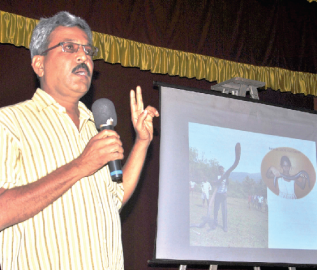
MARGAOCalling upon Goans to brace up for a sustained battle to oppose tooth and nail the diversion of Mhadei waters, environmentalist Rajendra Kerkar has said that drinking water would be the first casualty, followed by a dwindling fish catch if the Karnataka government is allowed to divert Mhadei river water from following into Goa.In the event of diversion of Mhadei river waters, Kerkar warned that a stage may come in the future people of Goa where they would be forced to…


