PANAJI
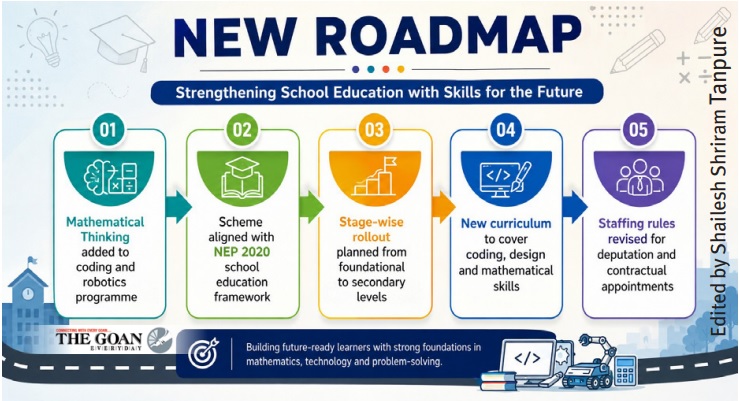
The State government has amended the Chief Minister’s Coding and Robotics Education in Schools (CM-CARES) Scheme to align it with the National Education Policy (NEP) 2020 by introducing Mathematical Thinking (MT), adopting a stage-wise implementation model and revising staffing provisions.
The amendments, notified by the Directorate of Technical Education, modify the scheme launched in May 2021, which was amended once earlier in March 2022. Under the revised scheme, Mathematical Thinking (MT) has been added to the list of abbreviations and definitions, expanding its focus beyond Computational Thinking (CT) and Design Thinking (DT).
The government has also revised the scheme’s objectives to gradually develop the required hardware, software and technical resources in government and government-aided schools. The initiative will now cover the Foundational, Preparatory, Middle and Secondary stages as prescribed under NEP 2020, before being extended to other classes if required.
The amended scheme also proposes the development of a curriculum covering Computational Thinking, Design Thinking and Mathematical Thinking, providing students with a wider learning framework.
The staffing provisions have also been revised. Personnel can now be appointed on deputation from government departments or government-aided institutions with applicable deputation allowance, or on a contractual basis for up to five years, as decided by the Empowered Committee. Eligible candidates include officers of the rank of Professor, Associate Professor, Assistant Professor, Head, Masters/Teacher Grade-I or equivalent.
According to the notification, the scheme will remain valid for three years from the date of its publication in the Official Gazette. The CM-CARES Scheme was launched to provide students in government and government-aided schools with skills in coding, robotics and emerging technologies. The latest amendments aim to bring the programme in line with the school education framework outlined in NEP 2020.