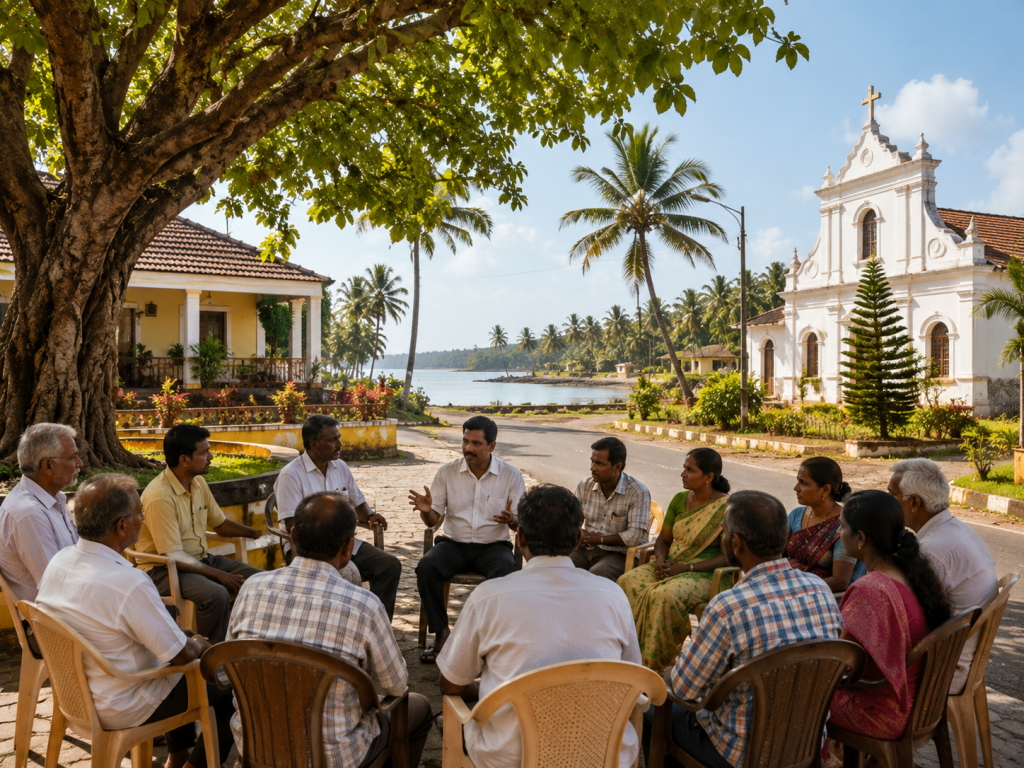

‘Ayushman Arogya Mandir - Public Health Center (AAM-PHC)’ is an upgraded public health facility model in India delivering comprehensive primary healthcare closer to communities, offering free essential medicines, diagnostic tests, and expanded clinical services.
Formerly known as Ayushman Bharat - Health and Wellness Centers, Goa has 24 PHCs which have been rebranded and upgraded as AAM-PHCs. According to reports, 14 of these operate 24x7.
It is truly remarkable how comprehensive rural healthcare has become in Goa!
Yet, despite the robust grassroots infrastructure, Goa’s public healthcare faces a severe bottleneck at the secondary and tertiary levels.
I sought the opinion of a few prominent doctors on this matter.
The primary causes are seemingly acute staff shortages, overcrowded superseniority facilities, and a sky-rocketing burden of lifestyle diseases that overwhelms the system faster than it can scale.
Peripheral district and sub-district hospitals suffer from severe specialist vacancies and lack critical diagnostic equipment.
Government healthcare systems generally prioritize primary care because it is the most cost-effective way to manage population health, acting as the first point of contact to prevent minor ailments from escalating into severe conditions.
‘Secondary’ and ‘Tertiary’ care are crucial for addressing illness beyond a general practitioner’s scope.
Secondary care provides specialized, acute, and surgical treatment, while tertiary care is highly specialized, complex medical care that requires advanced diagnostic support, complex surgical procedures, and intensive care units.
Tertiary care is provided in regional referral centers, major hospitals, or university medical centres equipped with advanced diagnostic tools and multidisciplinary expertise.
Yet, the perception of ‘step-motherly’ treatment in the healthcare sector is deeply tied to the structural divide between heavily subsidized public facilities and the largely unregulated private healthcare market.
The state’s aggressive focus on building and subsidizing its own public healthcare infrastructure has been creating pricing conflicts with private providers.
Goa’s healthcare model heavily centralizes advanced care at the state-run Goa Medical College and Hospital. The government has historically relied on GMC to provide tertiary services while attempting to support secondary care through public health insurance.
The state has focused its financial and infrastructural investments on expanding and upgrading the GMC. This centralization was intended to maintain a high standard of specialized care in one location rather than diluting resources across multiple smaller facilities.
Expanding secondary and tertiary care requires a massive influx of specialized doctors, intensivists, and medical officers. The state has continuously struggled to fill existing vacancies across its district hospitals and primary health centres, deterring the rapid expansion of advanced clinical departments.
While slower to build additional government-run tertiary facilities, the state, it is said, is actively working on decentralizing these services. The South Goa District Hospital (SGDH) is being actively upgraded to function as a secondary tertiary hub, and the state is developing specialized trauma and super-specialty blocks to offload the burden on GMC.
However, the local media has been quite acerbic about the fact that the SGDH in Margao struggles with operational and infrastructural deficiencies. Frequent patient grievances cite severe staff shortages, lack of specialized units, and reliance on referrals to the overloaded Goa Medical College, highlighting that the facility falls short of comprehensive tertiary care.
Besides the Goa Medical College, Goa has three prominent private tertiary and super-specialty hospitals. These institutions provide advanced clinical care and extensive diagnostic services across the state.
However, private tertiary and super-specialty hospitals in Goa have several key grievances against the government, primarily revolving around the delayed reimbursement of funds, strained patient management under state health schemes, regulatory pressures, and uneven operational competition. Advanced, highly specialized medical interventions like organ transplants and cancer management require sophisticated infrastructure, multi-disciplinary teams, and intensive care units found only in tertiary care centres.
Organ transplants (such as kidneys, livers, and hearts) fall into the tertiary care category because they involve complex surgeries, intense postoperative monitoring, and long-time specialized management.
Goa has established organ transplant centres, primarily for kidney and cornea transplants. Besides Goa Medical College and Hospital, facilities operating under the State Organ & Tissue Transplant Organization (SOTTO) include a few private hospitals.
The organ transplant landscape in India however exhibits severe regional disparities.
While Goa records fewer than five renal transplants monthly, states like Gujarat, Delhi, Tamil Nadu, Maharashtra, Telangana, and Andhra Pradesh dominate the sector due to expansive infrastructure, higher population densities, and robust cadaveric donation programmes.
Apparently, the Goa government has got its priorities all wrong by neglecting private healthcare players in the tertiary and super specialty sector in favour of a public healthcare system that shows no signs of moving forward in a definite manner.
There is a general consensus amongst medical practitioners that healthcare by the government should be a tiered service.
The lack of a strict referral protocol in Goa’s public healthcare system directly burdens tertiary institutions like the Goa Medical College. Unmanaged walk-in cases for minor issues cause overcrowding, increased wait times, and lead to significant service duplication, diverting specialists’ time from actual emergencies.
Healthcare provision by a government has to prioritize between Primary (which provides accessibility of care) and tertiary care (specialized care). This is because budgets need to follow the goal thereof, and ensure care for all or for the critical few.
A state must provide care, and access to care for citizens. Tertiary care, by its nature, will be pertinent to a small percentage of the population. Besides, for a government, budgetary allocation for ‘Tertiary’ care is disproportionate as compared to ‘Primary’ care.
In this context, partnership with private providers is potentially a win-win situation for all stakeholders. Private and government systems have to be complementary so as to enable the best healthcare services to a population.