A nine-year-old child walked up to her teacher. She did it once. Then again. Then again. Five times within the last 45 minutes of her life. She was not asking permission to leave the classroom or seeking help with homework. She was silently asking an adult to notice her distress. The recently released classroom CCTV footage in the Amaira Meena case is heartbreaking because it captures every parent’s worst fear and every teacher’s greatest regret—a child repeatedly reaching out while the adults around her fail to understand what she is trying to say. Moments later, she walked out of the classroom, climbed to the fourth floor of her school building and jumped to her death. She was only nine.
The investigation paints an even darker picture. Reports indicate Amaira allegedly endured bullying, teasing and humiliation for nearly 18 months. Her repeated complaints were reportedly dismissed, while her parents were allegedly told she simply needed to “adjust”. Today, the school has lost its CBSE affiliation, while the owner, principal and class teacher have been chargesheeted. Questions are also being raised under the Juvenile Justice Act. But no chargesheet or cancellation of affiliation can bring back a child who asked for help five times before giving up. It would be a grave mistake to treat this as only Jaipur’s tragedy. It is India’s tragedy. It is every school’s warning, including Goa’s.
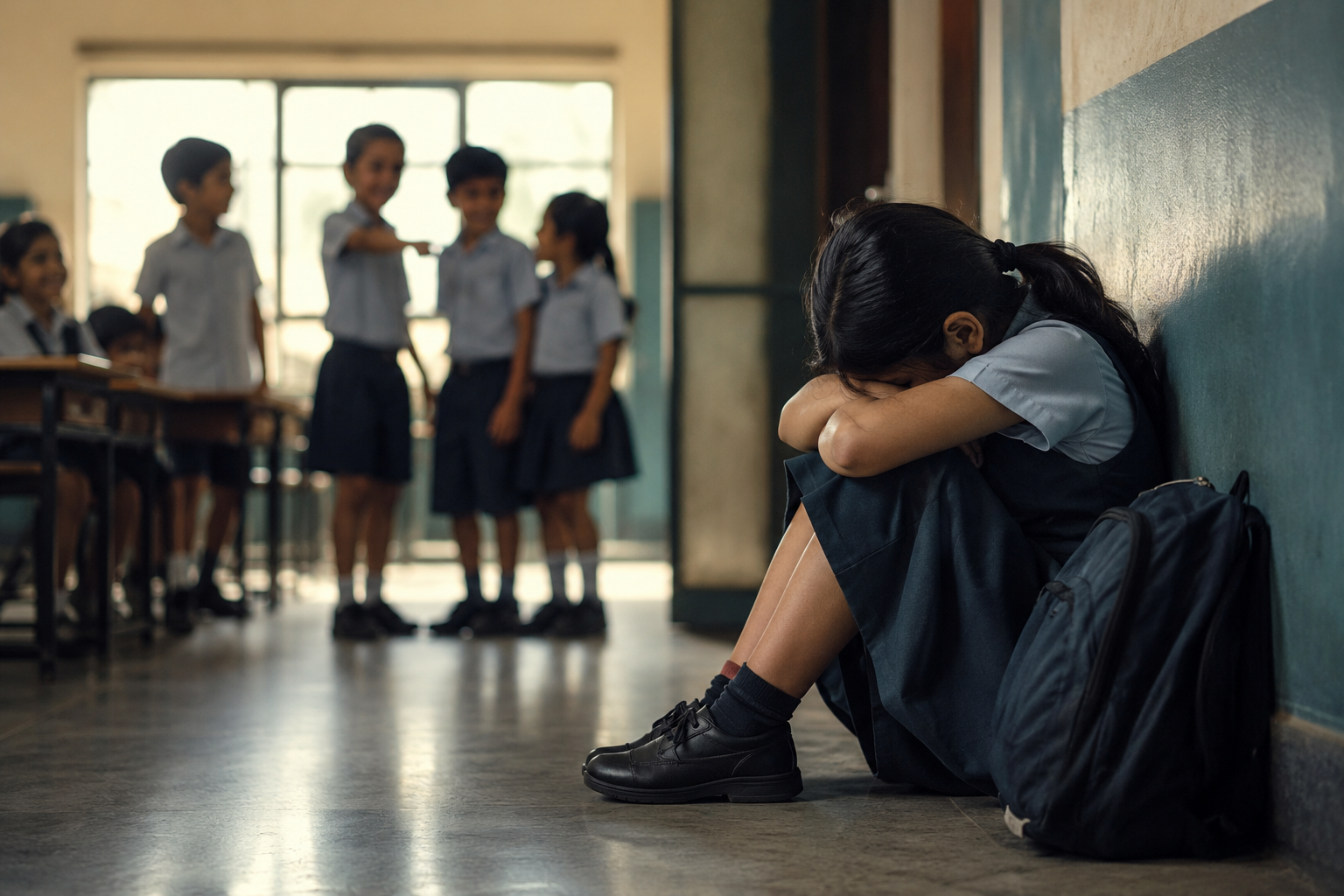
Bullying and cyberbullying have quietly grown in schools for years, yet they are still dismissed as harmless teasing, friendship issues or simply part of growing up. Adults often reassure themselves that children will sort things out. But bullying is not conflict. Conflict involves equals. Bullying involves an imbalance of power where one child repeatedly humiliates, excludes or intimidates another who struggles to defend themselves. When adults fail to intervene, the message to the victim is devastating: your pain does not matter.
This culture of minimising bullying extends beyond schools into many homes. Parents often advise children to ignore it, be stronger or learn to adjust. Somewhere along the way, we have normalised suffering instead of questioning the systems that allow it. Every time a child is told to “adjust” rather than being heard, we move one step closer to another Amaira.
During my tenure as Chairperson of the Goa State Commission for Protection of Child Rights, bullying and cyberbullying repeatedly emerged during interactions with students, parents and schools. It was clear this was no longer a routine disciplinary issue but a serious child protection concern. The Commission formally recommended that the Directorate of Education implement the National Commission for Protection of Child Rights (NCPCR) Guidelines for Elimination of Bullying and Cyberbullying in Schools across every school in Goa and sought an Action Taken Report.
The guidelines require every school to adopt an anti-bullying policy, constitute Anti-Bullying Committees, establish confidential reporting systems, train teachers and staff, conduct awareness programmes for students and parents, provide counselling, maintain complaint records and ensure prompt intervention. They recognise that prevention is as important as punishment.
More than two years later, important questions remain. Were these recommendations implemented? Were compliance audits carried out? Were teachers trained? Are Anti-Bullying Committees functioning? Do parents receive orientation? Do children know how to report bullying without fear of retaliation? These are questions every school management and the Directorate of Education should answer.
The challenge today extends far beyond the classroom. Children no longer leave bullying behind when the school bell rings. Cyberbullying follows them home through smartphones. Humiliating photographs, edited videos, anonymous Instagram accounts, exclusion from WhatsApp groups, cruel memes, fake profiles, gaming chats, online threats, AI-generated images and relentless digital harassment can continue around the clock. Schools cannot dismiss cyberbullying as someone else’s responsibility simply because it happens online. If it affects students’ learning, attendance, mental health and safety, educational institutions have a duty to respond.
Teachers already shoulder enormous responsibilities. Recognising bullying must become an essential professional skill. Children rarely say they are being bullied. Instead, they communicate through behaviour. They refuse to attend school, their academic performance declines, they become withdrawn, anxious or irritable, complain of headaches or stomach aches, lose confidence or stop participating. Some become aggressive; others become frighteningly quiet. Adults often try to correct behaviour while missing the emotional crisis behind it.
Parents also need to reflect honestly. We routinely ask about marks and homework, but how often do we ask whether someone hurt or humiliated our child today? Have we created homes where children feel safe enough to speak without fear of being dismissed? Equally important, we must accept that sometimes our own child may be the one doing the bullying. Child protection demands that parents confront both possibilities with honesty.
The Amaira case should become a turning point for every educational institution in Goa. Every school should immediately review its compliance with the NCPCR guidelines. Principals should certify that the required mechanisms are functioning. Teachers should receive regular training, School Management Committees should review complaints, every child should know where to seek help, and parents should be educated to recognise warning signs. Child safety cannot depend on chance encounters with compassionate teachers. It must be embedded in every school’s culture.
The haunting image from the CCTV footage is not of a child climbing a building. It is of a child walking towards an adult she believed would help her—five times. That image reminds us that the greatest failures occur long before a tragedy makes headlines.
As Goa prepares for another academic year, we must ask: How many schools have fully implemented the NCPCR Anti-Bullying and Cyberbullying Guidelines? How many Anti-Bullying Committees actually function? How many teachers have received specialised training? How many complaints have been formally recorded, and how many quietly buried to protect reputations? Most importantly, will Goa act now, or wait for its own Amaira before bullying and cyberbullying finally become priorities?